

The two largest music publishers on the planet have opened a new legal front against artificial intelligence. Late on Friday night, Sony Music Publishing and Warner Chappell Music filed a 48-page complaint in federal court in the Northern District of California, naming Anthropic, the company behind the Claude model, along with chief executive Dario Amodei and co-founder Benjamin Mann. The plaintiffs describe what they call one of the largest and most blatant ongoing thefts of intellectual property in history. Here is what the case actually contains, and why it reaches far beyond Anthropic.
What the complaint accuses Anthropic of
The heart of the allegation fits in a single line of the filing: Anthropic and its founders allegedly conducted a brazen campaign of illegally torrenting, scraping, and downloading copyrighted works on a massive scale in order to develop, operate and profit from the Claude family of models. In plain terms, the publishers are not only contesting the fact that the AI learned from their catalogues. They claim the files themselves were obtained through unlawful means, notably peer-to-peer sharing networks.
Two technical terms are worth defining. Scraping means automatically harvesting content published online. Torrenting refers to downloading through decentralised networks where files move directly between users, often without rights holders’ permission. The distinction matters in court: the first can still, in some cases, be argued under the American fair use doctrine, while the second is far harder to defend.
The complaint also accuses Anthropic of stripping the copyright management information attached to the files, the metadata identifying the author, the publisher and the terms under which a work may be used. Under US law, removing that information is a separate offence, independent of the infringement itself.
Tens of thousands of works, not a few hundred

What sets this case apart from earlier ones is its scale. The publishers claim Anthropic trained its models on tens of thousands of copyrighted compositions. By comparison, the complaint filed by BMG against the same company covered 493 compositions. The order of magnitude has changed.
Among the titles cited are absolute standards of the English-language repertoire: “Eye of the Tiger”, “Ain’t No Mountain High Enough” as popularised by Marvin Gaye, and Taylor Swift’s “Paper Rings”. The selection is deliberate. These are commercially released works with individual registrations, which opens the door to statutory damages.
Financially, the plaintiffs are seeking up to 150,000 dollars per infringed work and 25,000 dollars for each removal of copyright management information. Multiplied by tens of thousands of titles, those figures theoretically run into billions. The publishers are also demanding a jury trial, a strategy aimed as much at public opinion as at the legal record.
Why music is particularly dangerous ground for AI
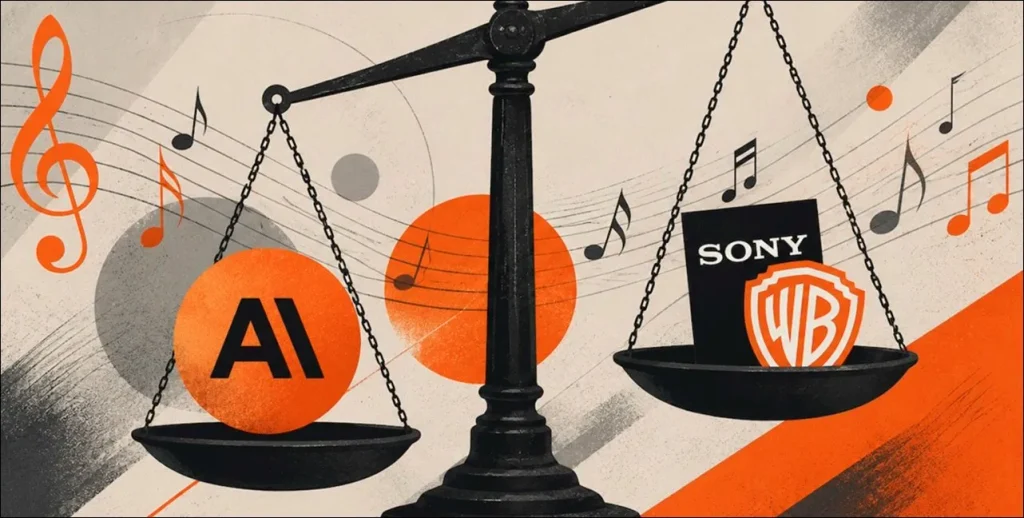
The legal structure of music largely explains how aggressive this offensive is. A single song can be split into several distinct rights: the lyrics, the musical composition and the sound recording. Each can belong to a different holder, spread across the writer, the publisher and the label.
The direct consequence, as Axios notes in its analysis, is that one song can trigger several parallel proceedings, brought by different parties over different layers of rights. An AI company that trained on a music catalogue therefore faces multiplied legal exposure compared with a corpus of text.
There is one more decisive factor: statutory damages. Unlike ordinary civil claims, this mechanism does not require the rights holder to prove a quantified financial loss. Establishing infringement of a registered work is enough to claim a fixed amount set by law. In mass litigation, that is considerable leverage.
Anthropic is no stranger to training-data litigation

This is not the first time the company has been accused of assembling its datasets through questionable means. In September 2025, Anthropic agreed to a 1.5 billion dollar settlement with book authors and publishers, the largest copyright settlement ever reached in the United States.
That precedent carries weight. It sets a de facto benchmark for the monetary value of an improperly acquired training corpus, and it gives music publishers a concrete figure to negotiate or litigate around.
The company is holding a clear defensive line. An Anthropic spokesperson stated: “We disagree with the publishers’ claims and we intend to defend ourselves robustly in court.” No element of the case has yet been ruled on by a judge, and the presumption of innocence remains fully intact.
What this fight changes for you
At first glance, a dispute between music publishing majors and an American AI lab looks remote from daily life. The stakes are in fact very concrete for anyone using a generative assistant.
First, on available features. The greater the legal pressure, the more model providers fence in their products. We already see systematic refusals to reproduce song lyrics, tighter guardrails on music generation, and filters that sometimes block perfectly legitimate uses.
Second, on the cost of services. If case law eventually mandates paid licences for training corpora, the bill will mechanically feed through to consumer subscriptions and programming interface pricing.
Third, on transparency. These proceedings force AI companies to document where their data came from. That is probably the most durable effect: in the medium term, training-set traceability could become a commercial argument, or even a regulatory obligation, much like food labelling.
Finally, on creation itself. The music industry has a long litigation history, from Napster to LimeWire. Each time it emerged with a new economic model, with streaming eventually replacing unauthorised downloading. It is not far-fetched to imagine a collective licensing system for AI training emerging from the same process.
A dispute that will run for years
Hasty predictions should be avoided. A complaint is not a conviction, and proceedings of this size are measured in years, not months. The substantive questions remain open: to what extent does training a model fall under fair use? Does the method of acquiring the files change the legal nature of the analysis? Does a model that never reproduces a work verbatim still infringe?
What can be said, however, is that the balance of power has shifted. For two years, AI labs moved faster than the law. With Sony and Warner across the table, they now face opponents with documented catalogues, seasoned legal teams and a litigation culture decades in the making. The next chapter will play out in San Francisco, and it will matter well beyond Anthropic.
Do you think a licensing system for AI training is the only workable outcome? Share your view in the comments, and find all our artificial intelligence coverage on Wanda-techs.com.
Share this content: