

The Huawei Mate XT 2 goes official in China on 7 September, and it brings two significant changes: a redesigned hinge that drops the Z-shaped fold, and HarmonyOS 7 in its first commercial appearance. The event was set for 14:30 Beijing time, under the title “HarmonyOS 7 | HUAWEI Mate XT 2 and All-Scenario New Product Launch”. This third-generation tri-fold matters well beyond the Chinese market, and here is why.
The Huawei Mate XT 2 drops the Z-shaped fold
You cannot miss the difference. Huawei’s first two tri-folds, the Mate XT Ultimate Design and then the Mate XTs, folded in a Z pattern: one panel tucked in, the other stayed out. Elegant on paper. Rather less so in the pocket, since a third of the flexible display stayed exposed at all times, closed device included.
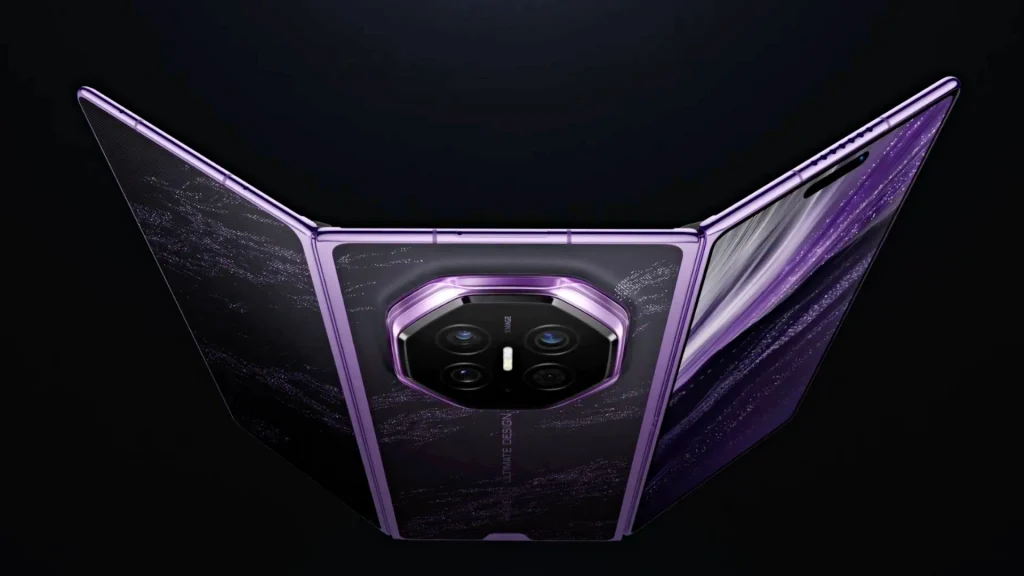
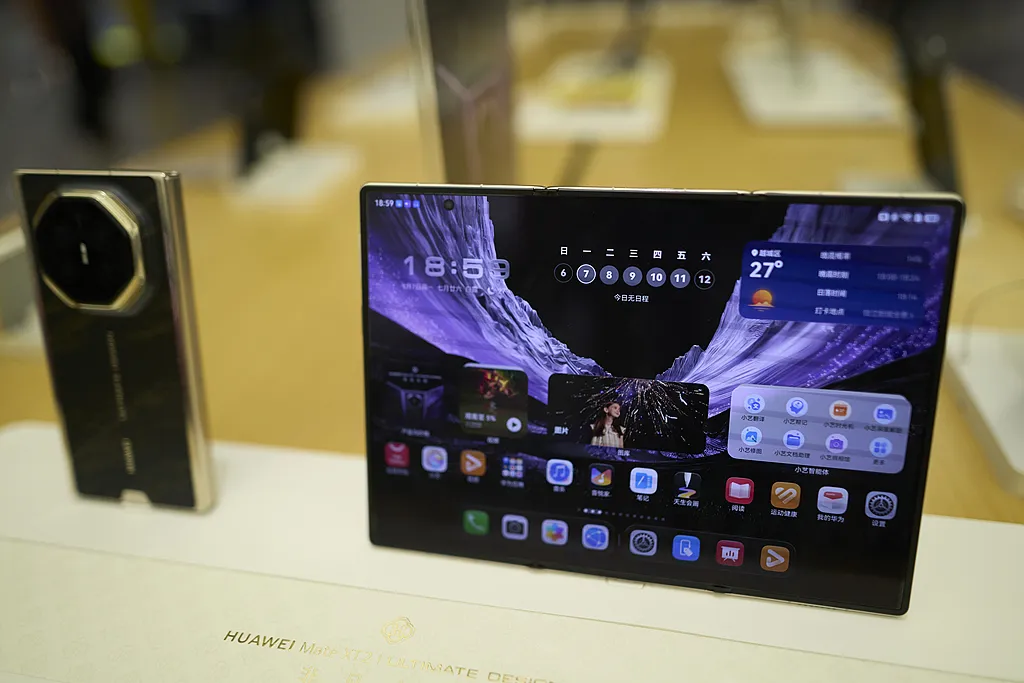
The Mate XT 2 reverses that logic. Both side panels now fold over the centre section in a U-shaped movement, and the flexible screen disappears entirely once the device is shut. Huawei therefore adds a separate cover display on the back for regular phone use.
Two gains follow. Protection first: the flexible panel, the most fragile and most expensive part of any foldable, no longer meets keys and grit at the bottom of a pocket. Then flatness, one of the recurring complaints about the original Mate XT. Leaks circulating before the announcement pointed to roughly a 20% improvement on that specific point.
What we know about the specifications
Huawei traditionally says little ahead of launch day, and the information circulating before the event came from leaks. Treat it with the usual caution until the full official spec sheet is published.
- Processor: a Kirin 9050 Pro is the name that comes up most often, although a Kirin 9030S has also been mentioned.
- Battery: over 6,000 mAh, against 5,600 mAh on the Mate XT Ultimate Design.
- Software: HarmonyOS 7, with the Mate XT 2 as its first commercial host.
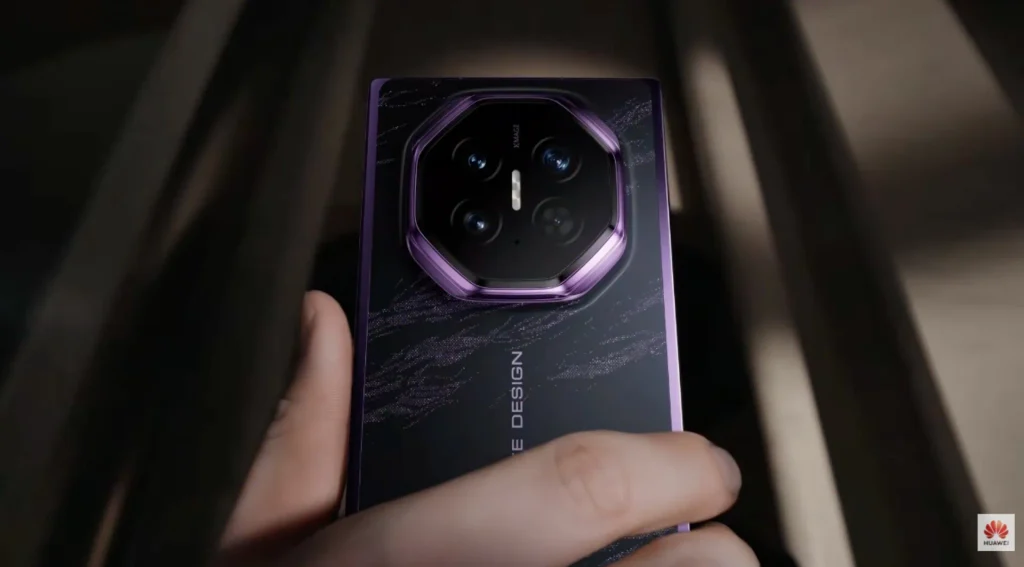
- Colours: Huawei showed a purple version ahead of the announcement.
For context, look at the previous generation. The Mate XT Ultimate Design offered a 6.4-inch screen closed, 7.9 inches half-open and 10.2 inches fully unfolded, a Kirin 9010 chip, a 5,600 mAh battery and a triple camera made up of a 50-megapixel main sensor with variable aperture, a 12-megapixel ultra-wide and a periscope lens with 5.5x optical zoom.
HarmonyOS 7 is the real story of the event
The Mate XT 2 is the showcase. Long term, though, the software announcement probably carries more weight. HarmonyOS 7 was unveiled in June 2026 at Huawei’s developer conference; today it enters commercial service.
The system adopts a more translucent visual language, with buttons, sliders and panels treated as layered glass surfaces. Huawei adds what it calls spatial personalisation, which can turn a scene into a three-dimensional effect displayed on the home screen.
On the AI side, the in-house assistant gains generative abilities: writing text, answering questions in real time, carrying out system-level tasks. The built-in photo editor also picks up a set of automatic tools, from image restoration to generative fill and object removal.
Huawei claims up to 15% better performance overall, spread across app launches, general responsiveness, gaming and animation smoothness. Six anti-fraud features arrive to flag scam calls, malicious links and fake websites. The rollout is then set to extend to the company’s tablets, PCs, wearables and smart home devices.
Three tri-fold generations in two years
The pace Huawei has set on this format is worth pausing over. In September 2024, the Mate XT Ultimate Design created the category: the first commercial three-panel smartphone, unfolding to 10.2 inches, roughly the surface of a small tablet. The international press mostly remembered the price, 19,999 yuan at entry level, and the engineering feat of a panel able to survive two separate creases.
The Mate XTs followed, refining the formula without touching the principle: still a Z-fold, still a slice of screen left exposed. A consolidation step, the kind that often sits between two real breaks.
The Mate XT 2 is that break. By moving to an inward fold with a cover display on the back, Huawei adopts the logic that already dominates conventional foldables, from the Galaxy Z Fold to rival Chinese models. This is no cosmetic detail: it drives the device’s durability, its resistance to scratches and, by extension, any chance of it becoming something other than a showcase piece.
That leaves weight and thickness, the sworn enemy of the format. Stacking three panels, two hinges and a battery above 6,000 mAh leaves very little room. That is exactly where this third attempt will be judged, and early hands-on impressions will answer more than any spec sheet can.
A price that stays out of reach
No surprise here: the tri-fold remains a technology showcase before it is a mass-market product. Estimates circulating before the announcement placed the Mate XT 2 somewhere between 15,000 and 20,000 yuan.
The previous generation offers a useful reference point. The Mate XT Ultimate Design launched at 19,999 yuan for 256 GB, 21,999 yuan for 512 GB and 23,999 yuan for 1 TB. Its international version carried a €3,499 price tag.
Why this launch matters outside China
Huawei no longer sells its high-end smartphones in Europe under the same conditions as before the US sanctions, and the absence of Google services remains a real obstacle for a European buyer. For most readers, then, the Mate XT 2 will not be a serious candidate to replace their current phone.
The interest lies elsewhere. Huawei has held the tri-fold segment almost alone for two years, and every iteration acts as a laboratory for the whole industry. Samsung has shown its Galaxy Z TriFold; other Asian manufacturers are watching. Panel protection, flatness, thickness: the trade-offs settled here will eventually filter down into far more affordable devices.
HarmonyOS 7 tells a different story: an operating system now fully detached from Android and pushed across an entire hardware ecosystem. The strategy deserves attention, if only because it is the only credible attempt so far at building a third mobile platform alongside Android and iOS.
What still needs confirming
Several points await full official confirmation: the exact resolution and brightness of the panels, the final camera configuration, real-world battery endurance and, above all, availability outside China. The Mate XT Ultimate Design did eventually go international; nothing guarantees the Mate XT 2 will follow the same path, or how quickly.
We will update this article as soon as the complete spec sheet and final pricing are published.
Does the tri-fold finally look useful to you, or is it still a showcase piece? Tell us in the comments, and find our other foldable phone coverage on Wanda-techs.com.
Share this content: