Comparison of Nvidia RTX 5080 vs 4080 graphics cards: What’s different?
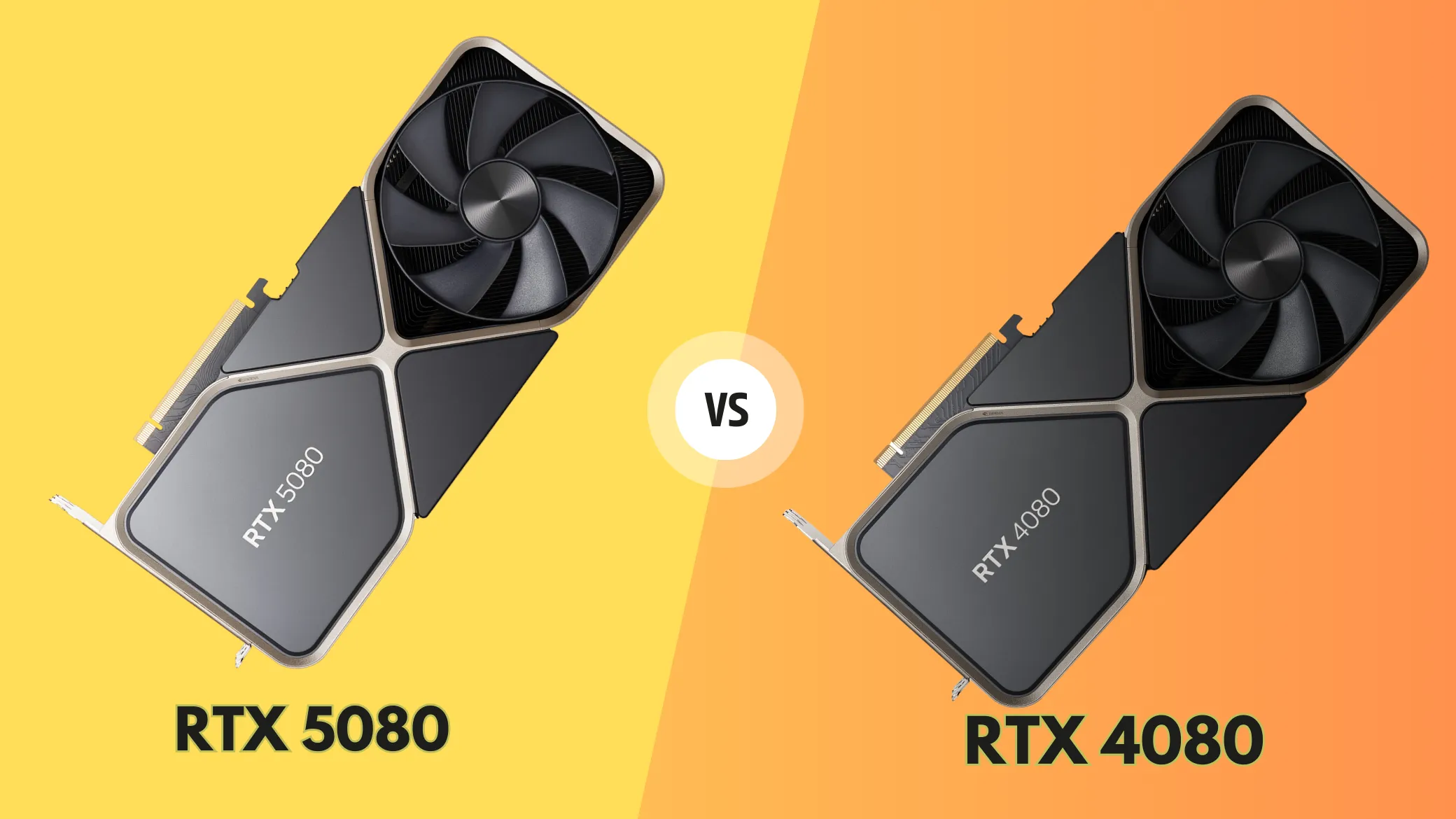
In the world of graphics cards, Nvidia stands as the undisputed leader, consistently delivering major innovations. At CES 2025, Nvidia finally announced the GPUs everyone had been waiting for: the RTX 50 series. Although the company did not reveal the entire lineup, it confirmed four GPUs, including the RTX 5080. Like the rest of the RTX 50 series, the RTX 5080 is based on the new Blackwell architecture and brings major improvements in performance and AI, particularly DLSS 4. So, keep reading to find out how the RTX 5080 compares to the RTX 4080.
Sizing: The Nvidia RTX 5080 becomes slimmer

Nvidia has traditionally increased the size of its graphics cards with each generation, as seen with the RTX 4080, which was much larger than its predecessor, the RTX 3080. This trend changes with the RTX 50 series, which is slightly smaller, allowing it to take up less space on the motherboard. The RTX 4080 FE measures 310 mm × 140 mm × 61 mm, while the RTX 5080 is more compact at 304 mm × 137 mm × 40 mm.
In addition, the RTX 5080 is a 2-slot card, whereas the RTX 4080 is a 3-slot card. This means the 5080 is thinner despite having a 40 W higher TDP, allowing it to occupy less space inside your system.
Memory: RTX 5080 launches with 16 GB of VRAM
The RTX 5080 launches with the same memory capacity as its predecessor (4080), namely 16 GB of VRAM. However, the 5080 features the latest GDDR7 memory, which is faster than the GDDR6X used in the 4080. Furthermore, the RTX 5080 delivers up to 960 GB/s of total memory bandwidth, representing a significant 34% increase compared to the 717 GB/s provided by the RTX 4080.
Performance:

In terms of core count, the RTX 5080 features 10,752 CUDA cores, while the RTX 4080 has 9,728 CUDA cores. Although the difference is not as large as between the RTX 5090 and 4090, the 5080 still offers over 1,000 additional cores, enabling better performance—especially when combined with improved memory and architecture.
The RTX 5080 runs at a base clock of 2.30 GHz and can boost up to 2.62 GHz. In comparison, the RTX 4080 offers base and boost clock speeds of 2.21 GHz and 2.51 GHz, respectively. It is therefore clear that the RTX 5080 outperforms its predecessor in terms of clock speeds.
Now, let’s talk about real-world performance. Several tests show that performance depends on average frames per second (FPS); however, both GPUs are excellent for gaming. Here’s how the RTX 4080 and RTX 5080 compare in popular games:
The RTX 4080 is 11% faster in 1080p (231 vs 209 FPS)
Both GPUs are tied in 1440p (161 FPS)
The RTX 5080 is 5% faster in 4K (110 vs 105 FPS)
Here are some notable performance differences observed across popular titles:
In Metro Exodus, at 1080p with high settings, the RTX 4080 is 228% faster.
In The Witcher 3: Wild Hunt, at 4K with high settings, the RTX 5080 is 26% faster.
Features: Nvidia RTX 5080 supports DLSS 4

Nvidia continues to focus on advancing its AI technologies, and at CES 2025, it introduced the latest version of its upscaling technology: DLSS 4. For those unfamiliar, DLSS is designed to boost FPS in games, especially useful for users with lower-end RTX cards struggling to achieve smooth performance.
Currently, RTX users have access to DLSS 3.5, but they will upgrade to the new version once it launches later this month alongside two RTX 50 series GPUs. While the RTX 5080 already offers better performance than the 4080, it will reach another level with DLSS 4. One of its features, Multi-Frame Generation, will be exclusive to RTX 50 series cards.
Additionally, Nvidia announced a brand-new version of its latency reduction technology, Reflex 2. At present, Reflex 1 helps make gameplay smoother by cutting latency nearly in half. The new version will introduce a feature called Frame Warp to reduce latency even further. With DLSS 4 and Reflex 2, the RTX 5080 will see a significant performance boost over the RTX 4080.
Price and availability:
The Nvidia RTX 5080 was announced on January 6, 2025, and officially released on January 30. Prices start at $999 for the 16 GB version. In contrast, the Nvidia RTX 4080 was announced two years earlier, on January 3, 2022, and launched on February 8 of the same year, with prices starting at $899 for the 12 GB model and $1199 for the 16 GB version.
Nvidia RTX 5080 vs 4080: Value for money verdict
In conclusion, the comparison between the Nvidia RTX 5080 and RTX 4080 highlights significant differences that may influence your decision depending on your priorities—whether it’s raw performance, energy efficiency, or overall value for money. The RTX 5080 is clearly a solid upgrade over the RTX 4080 thanks to faster performance, improved AI capabilities, DLSS 4, higher memory bandwidth, and more.
Moreover, with DLSS 4 and Reflex 2, it is expected to significantly outperform the 4080. Despite a relatively small price difference of around $100, the final choice will depend on your specific needs, budget, and intended use. In any case, Nvidia continues to push the boundaries of graphics technology and inspire the next generation of visual performance.
Also read:
Share this content:







Leave a Reply