
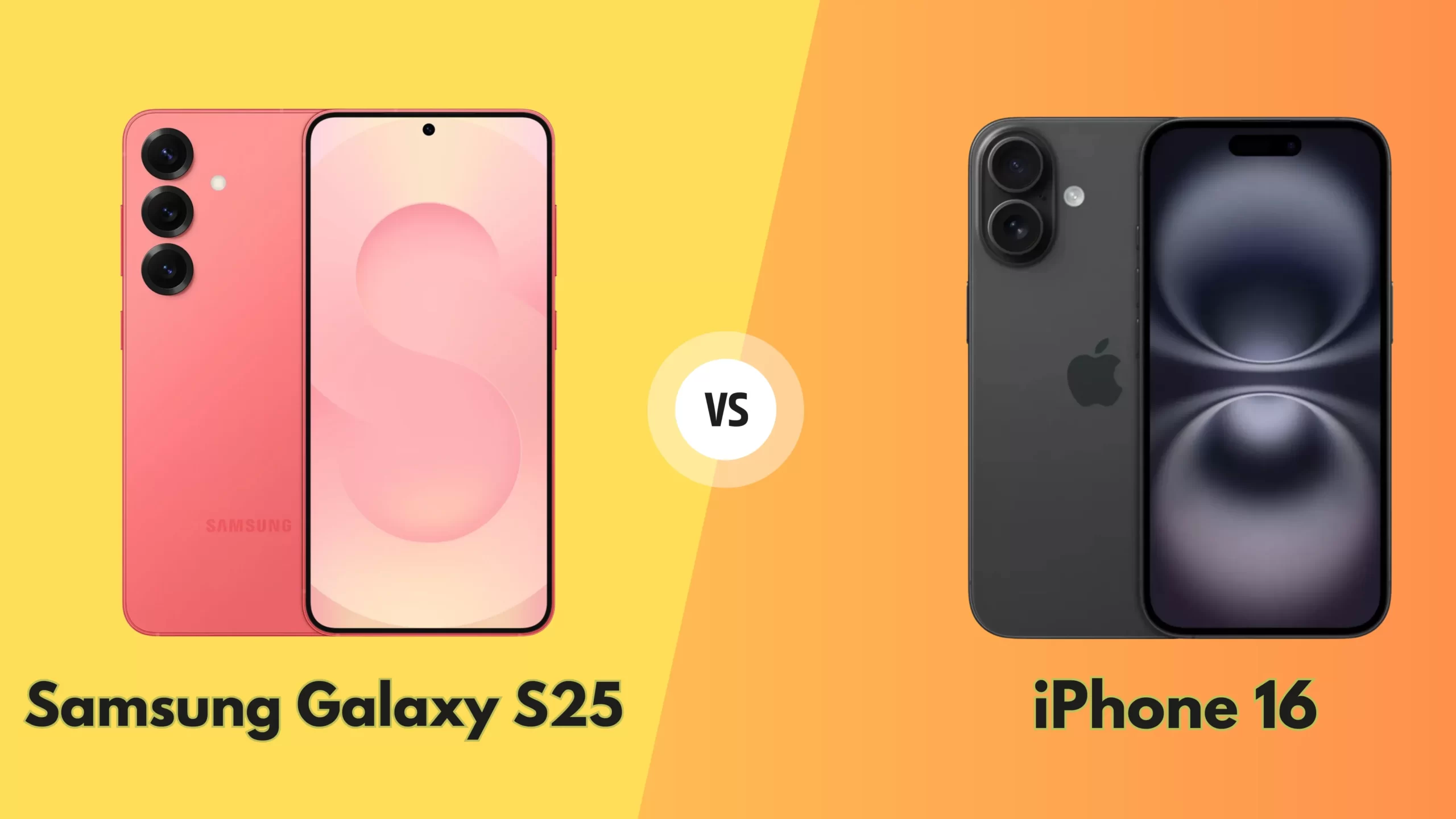
Samsung has just unveiled the new Samsung Galaxy S25 series during its traditional “UNPACKED” event this year. This series is positioned as high-end smartphones by Samsung. However, with the iPhone 16 series having been available since September 20 September 2024, it could see the S25 series steal the market spotlight. So, which one best meets your expectations? You will find the answer in this comparison between the Galaxy S25 and the iPhone 16.
Design: Points go to the Galaxy S25
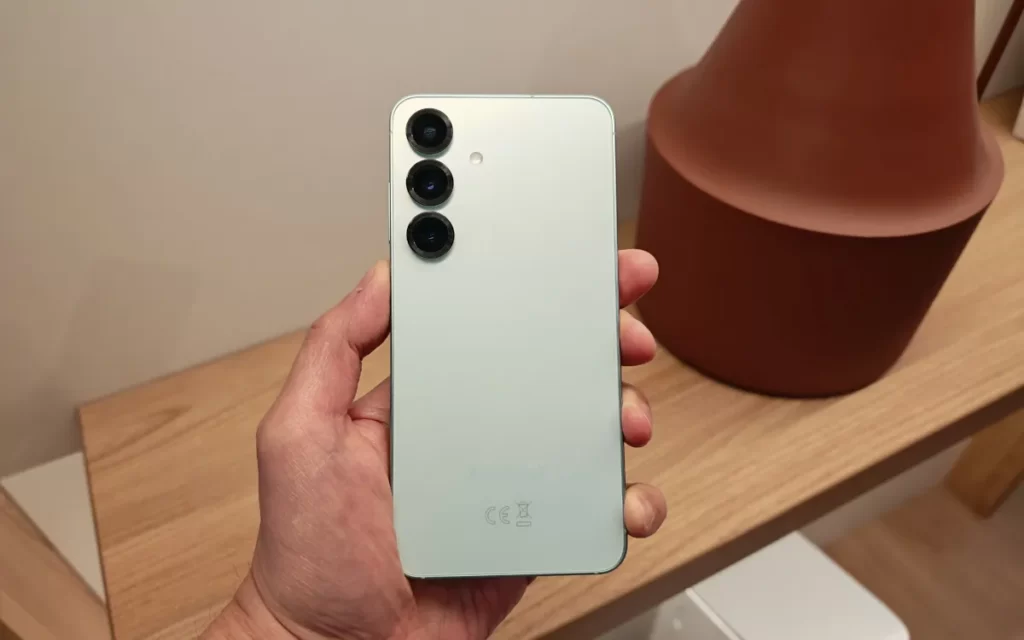
Regarding design, the Samsung Galaxy S25 appears to be thinner than the iPhone. Indeed, it measures only 146.9 x 70.5 x 7.2 mm compared to 147.6 x 71.6 x 7.8 mm for its rival, making the S25 more comfortable to hold. With its slim bezels, it is narrower and shorter than the iPhone 16. The frame features flat edges and rounded corners on both sides. Additionally, both phones are made of aluminum and are IP68 certified for water and dust resistance.
There are 3 sensors perfectly integrated into the glass back (Gorilla Glass Armor 2) of the Galaxy S25. As a result, the Galaxy S25’s camera module is more attractive than that of the iPhone 16, where the sensors are less seamlessly blended. On the front, however, Samsung’s centered punch-hole for the selfie camera is much more discreet than Apple’s Dynamic Island, which houses the Face ID sensors.
Display: Very low refresh rate on the iPhone 16

The Galaxy S25 screen is a 6.2-inch Dynamic LTPO AMOLED 2X compared to 6.1 inches for the iPhone 16. Samsung’s display is therefore larger, even if the resolution is higher on the iPhone. The Galaxy features a Full HD+ definition of 2,340 x 1,080 pixels, for a density of approximately 416 pixels per inch. The iPhone 16, for its part, has a Super Retina XDR OLED screen with a definition of 2,556 x 1,179 pixels, giving it roughly 460 pixels per inch.
Now let’s talk about the refresh rate, where Samsung is far superior. The Galaxy S25’s goes up to 120 Hz compared to 60 Hz for the iPhone 16. Additionally, the Always-On Display is present on the Galaxy but absent on the iPhone 16. Both offer an impressive 19.5:9 ratio, with HDR handled by HDR10+ technology at Samsung and Dolby Vision at Apple.
Performance: A18 still at the top
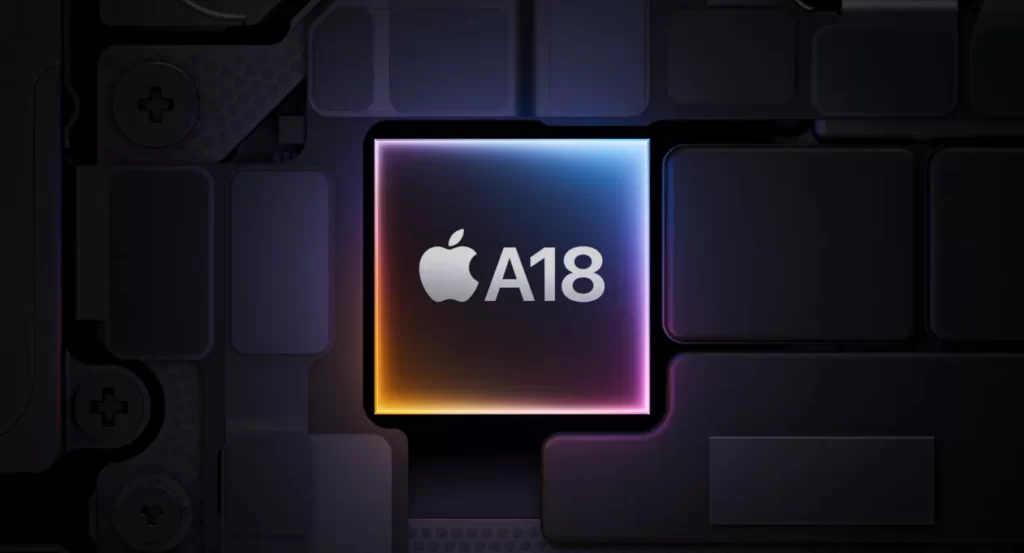
Under the hood, Samsung aims to close the gap with Apple by equipping the Galaxy S25 with a Snapdragon 8 Elite for Galaxy chip, a customized version of Qualcomm’s Snapdragon 8 Elite. However, although the power is there, it should not be enough to rival the iPhone 16’s A18 chip. The Galaxy S25 packs 12 GB of RAM across all possible configurations compared to 8 GB of RAM for the iPhone 16.
Both handsets offer the same storage options: 128, 256, or 512 GB, using UFS 4.0 for Samsung and NVMe for Apple. The Galaxy S25 is equipped with a USB-C 3.2 connection, which offers faster speeds than the iPhone 16’s USB-C 2.0 port. Wired file transfer is therefore faster on the Samsung than on the Apple. For wireless connectivity, Wi-Fi 7, 5G, and NFC are present on both models. We also note a more recent Bluetooth version on the Galaxy S25 (5.4) than on the iPhone 16 (5.3).
The New Era of AI Arrives on the Samsung Galaxy S25 Series
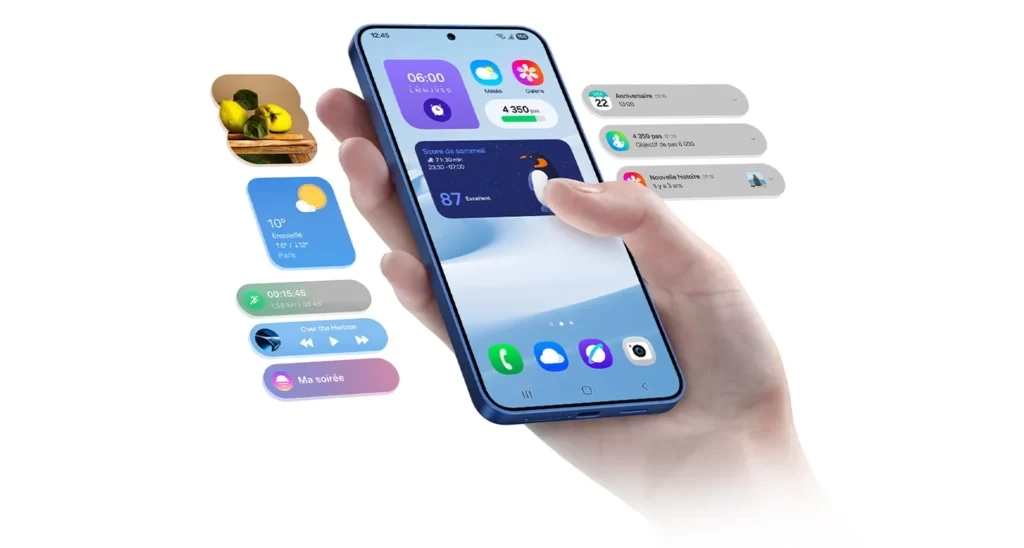
Samsung aims to be a smartphone AI pioneer through close collaboration with Google. With its Galaxy S25, the firm wants to offer an intelligent partner that anticipates all its users’ needs. This super assistant should respond to your requests, leveraging Gauss, Gemini, or Bixby depending on what is most relevant.
- Now Brief: This is a notification bar integrated into the lock screen, giving you an overview of the day ahead by summarizing your appointments, for example. Now Brief provides the information you need throughout the day.
- Circle to Search: This feature allows you to perform instant searches on anything on the screen. You just need to circle an object with your finger to get immediate results. Also, you can search for a song you are listening to without leaving the application.

- Audio Eraser: Here, you have the latitude to get rid of unwanted background noise from videos and make them perfect. You can adjust different sounds, including voice, music, wind, and more.
In view of all these features, although they haven’t all been listed, we see that Samsung is a step ahead of Apple. We will see what Apple offers with Siri to compete with Samsung AI.
Photography: The telephoto lens is missing on the iPhone 16
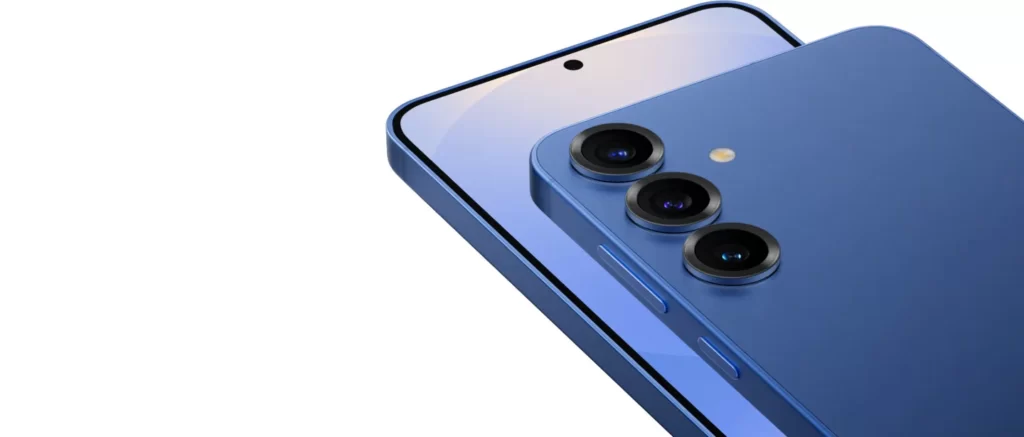
The Galaxy S25 returns with a triple camera sensor, consisting of a 50 MP wide-angle, a 12 MP ultra-wide-angle, and a 10 MP telephoto lens. The latter allows for a 3x optical zoom, while it is possible to obtain a 2x zoom by cropping into the main optics.
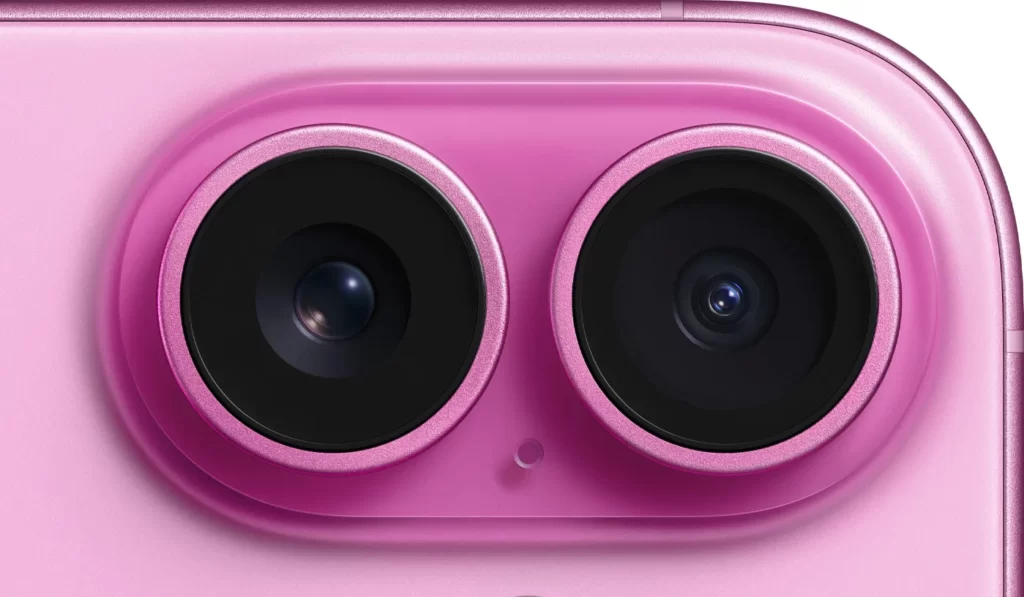
The iPhone 16, for its part, does not have a true optical zoom, as it lacks a telephoto lens—a feature reserved for the Pro models. However, it is possible to play with the focal length of the 50 MP wide-angle sensor to tighten the field of view. It is complemented by a 12 MP ultra-wide-angle.
As for the front camera, both models have a 12 MP wide-angle sensor, but with different image processing technologies. Therefore, based on current specs and the shots produced by the Galaxy S24, the new model should be superior to the iPhone 16 in photography.
Software: Android or iOS
One difference that practically cannot change is the use of Android for Samsung and iOS for Apple. The Galaxy S25 ships with One UI 7, the manufacturer’s house overlay based on Android 15. The iPhone 16, meanwhile, ships with iOS 18. Samsung promises at least seven years of updates and security patches for its Galaxy S25. Apple, for its part, does not communicate a guaranteed duration of software support, but we know the manufacturer is very serious about device follow-up.
Battery Life: Somewhat amusing battery capacity
The batteries of these two models are small due to their very compact format. We find a capacity of 4,000 mAh for the Galaxy S25 and 3,561 mAh for the iPhone 16. Clearly, this is a weak point for both models, especially in a world where the trend for new phone batteries oscillates between 5,000 and 7,000 mAh.
Charging is also quite slow on both sides, with 25 W wired power. Regarding wireless charging, both devices support 15 W. The iPhone 16, however, can go up to 25 W via induction charging if you use the MagSafe protocol, which requires investing in a specific product.
Price: The iPhone 16 is more expensive
Prices vary depending on the different configurations of the Galaxy S25 and iPhone 16:
Galaxy S25 with its 12 GB of RAM:
- 128 GB: 899 euros
- 256 GB: 959 euros
- 512 GB: 1,079 euros
iPhone 16 with its 8 GB of RAM:
- 128 GB: 969 euros
- 256 GB: 1,099 euros
- 512 GB: 1,349 euros
Conclusion: Much better value for money with the Galaxy S25
In conclusion, the excellent value for money of the Galaxy S25 makes it the best choice for both capacity and photography. What exceptionally makes the latter a dream smartphone is, above all, its AI features. However, if you are an iOS enthusiast, you will inevitably choose the iPhone 16 despite its exorbitant prices.
Read also:
- Samsung Galaxy A16 vs. Samsung Galaxy A15
- Oppo Reno 13 vs. Redmi 14 Pro
- Common iPhone 16 problems and their solutions
Share this content: