
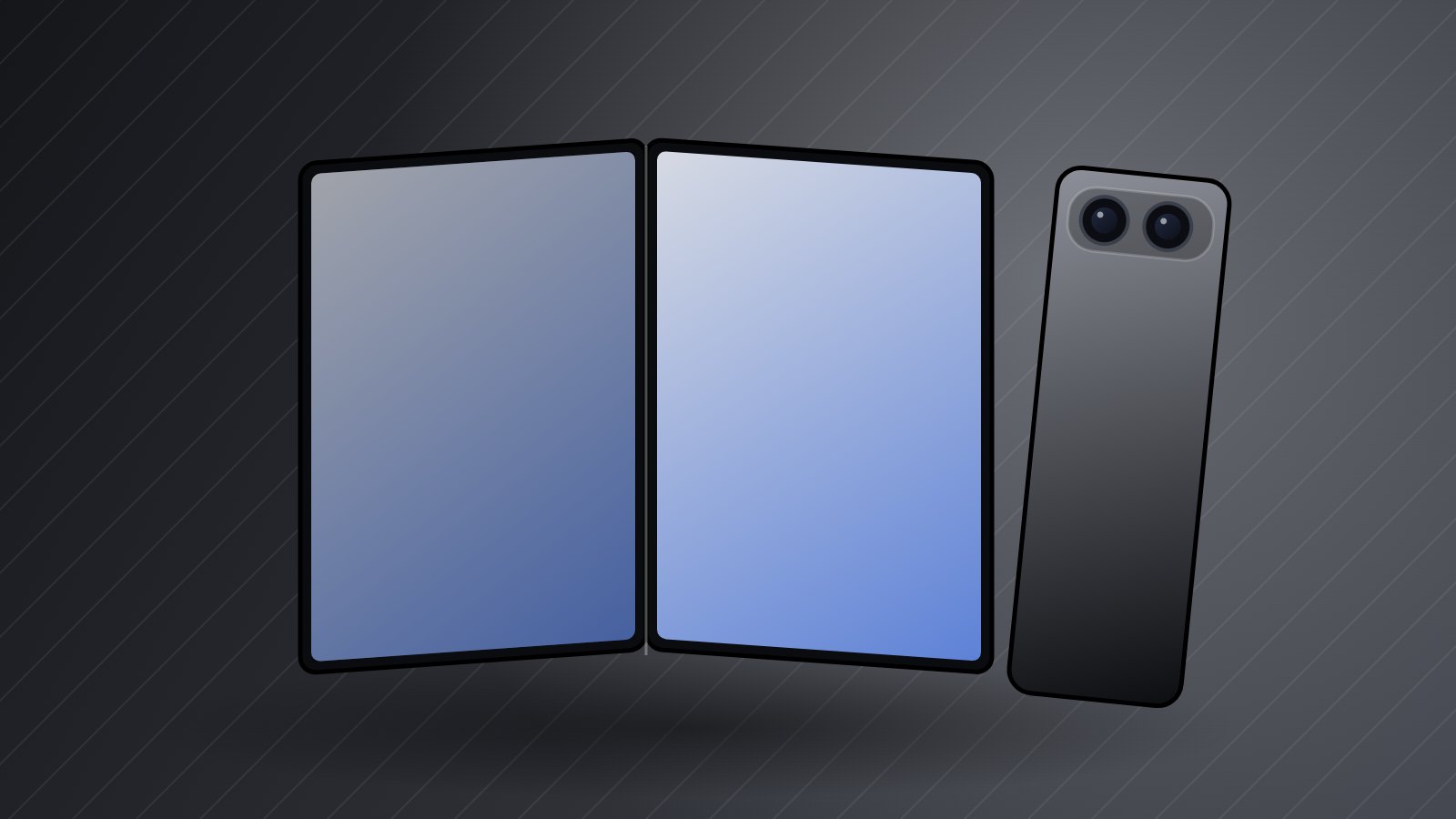
The iPhone Duo, Apple’s first foldable iPhone, starts at €2,339 (about 1,534,000 FCFA) and will only reach buyers on 23 October 2026, a week after pre-orders open. On paper it carries two things Samsung cannot match: an IP68 rating and the A20 Pro chip. It also weighs 254 g and gives up both Face ID and the telephoto lens. No newsroom has held one for more than a few minutes. So this page sorts what is certain from what is likely and what is still foggy.
Introduction: the iPhone Duo, seven years after the first Fold
Apple took its time. Samsung was selling its first Galaxy Fold back in 2019; Cupertino waited until 9 September 2026 to show its own, at the tail end of an already crowded keynote. The rumour mill had called it the iPhone Fold, then the iPhone Ultra. Duo it is.
How the announcement unfolded is a story for a news piece on Apple’s foldable, its price and its release date. We won’t retell it here. Treat this page as the reference sheet for the iPhone Duo: specifications, form factor, pricing, and the kind of buyer it suits.
First, some bearings. The iPhone Duo costs €860 more than an iPhone 18 Pro and €710 more than an iPhone 18 Pro Max, while offering less than either in photography and biometrics. The money buys a shape. A longer spec sheet is not part of the deal.
Verdict in brief: our provisional take on the iPhone Duo
No score for now. The iPhone Duo is not on sale, and the only published impressions come from short demo sessions held after the keynote, with Apple staff looking on.
Awaiting review — a first foldable that looks carefully finished, sealed against water and dust, and fast, but whose weight, omissions and price keep it for the already convinced. Real-world battery life, how the hinge ages and what a repair costs are all unknown.
- Who it is for: iPhone, Mac or iPad owners who read, write and watch a great deal on their phone, and for whom budget is no obstacle.
- Avoid if: you shoot distant subjects, you are attached to Face ID, or your carrier does not offer eSIM.
What looks promising:
- A crease the American press on site found very discreet
- The IP68 rating, a rarity on a foldable
- The A20 Pro chip, built on a 2 nm process
- Split View on an iPhone, at last
Still to be confirmed:
- Day-to-day stamina when the inner screen does the work
- Hinge durability, for which Apple gives no figure at all
- The quality of the camera tucked under the panel
- Launch stock and the price of AppleCare
iPhone Duo specs
| Écran principal | OLED pliable 7,6 pouces, 120 Hz, 3 000 nits, finition nano-texturée |
|---|---|
| Écran externe | OLED 5,4 pouces, 120 Hz |
| Processeur | Apple A20 Pro (2 nm) |
| Mémoire vive | Non communiquée par Apple (12 Go selon bases tierces) |
| Stockage | 256 Go, 512 Go, 1 To, 2 To |
| Appareil photo arrière | 48 Mpx f/1,6 + ultra grand-angle 48 Mpx f/2,2, sans téléobjectif |
| Caméras selfie | 12 Mpx Center Stage (externe) + caméra sous l'écran (interne) |
| Batterie | Double batterie, capacité non communiquée ; jusqu'à 31 h (int.) / 44 h (ext.) de vidéo |
| Charge | 50 % en 20 min environ en filaire ; MagSafe 25 W |
| Dimensions plié | 84,1 x 117,8 x 11,3 mm |
| Épaisseur déplié | 5,2 mm |
| Poids | 254 g |
| Étanchéité | IP68 |
| Launch price | 2 339 € |
Three lines of that table matter. The 254 g first, which is 53 g more than the Galaxy Z Fold 8. Then IP68, guaranteed down to 6 metres for 30 minutes. And a gap. Apple publishes neither the battery capacity nor the amount of RAM, and the databases quoting 12 GB cite no official source.
Design of the iPhone Duo: polished titanium, and half a kilo for a pair
Stack two of them and you are close to half a kilo. A shirt pocket will know this phone is there.
More notebook than remote control
Closed, the device stands 117.8 mm tall, 84.1 mm wide and 11.3 mm thick. Short, wide, stocky. Opened flat it stretches to 164.6 mm across and slims down to 5.2 mm, which Apple says makes it the thinnest iPhone it has ever built.
The frame is grade 5 titanium with a mirror polish. Lovely in a shop window. Kerry Wan of ZDNET is already worried about how slippery those shiny edges will be. There are two finishes and no more, which Apple’s French store lists under names that translate as stellar white and night sky: for this money, a little daring would have been welcome.
Touch ID returns, the Action button goes
A half that is 5.2 mm thick leaves no room for Face ID, so Apple took it out. Unlocking falls to a fingerprint reader set into the side button, which works with the phone open or shut. Raymond Wong at Gizmodo calls it a small step backwards. We agree with him: wet hands, motorbike gloves, fingers slick with frying oil, and the print fails where a face used to get through.
The Action button is gone too. Camera Control, for its part, stays where it was.
Foldable format: how the iPhone Duo handles the crease, the hinge and water
You can spot a bad foldable quickly: a groove that snags the finger, a hinge that works loose, a grain of sand that scores the panel.
The crease: easy to miss, still there
The American reporters who handled the foldable iPhone after the keynote tell more or less the same story. Allison Johnson of The Verge struggles to feel it under her finger yet sees it from certain angles. Sam Rutherford, writing for Engadget, finds it easier to feel than to see. Juli Clover of MacRumors rates it above Samsung’s.
In plain terms, the groove exists and Apple has hidden it better than most. Bear in mind that these opinions concern brand-new units, in a room the manufacturer picked. A crease is judged after six months.
The hinge: a hundred parts and not one number
Apple describes a mechanism of more than a hundred parts, capped by a 3D-printed titanium cover. Early accounts speak of a smooth opening action that holds whatever angle you leave it at.
Then the silence sets in. Samsung quotes 500,000 folds for its Galaxy Z Fold 8; Apple publishes no cycle count whatsoever. Analyst Jeff Pu, quoted by 9to5Mac, in fact blames this demanding component for the cut in production, now put at 6 million units for 2026.
Thickness and cover screen: what closed-phone comfort costs
At 11.3 mm, the closed iPhone Duo is thicker than the Fold 8 (9.7 mm) and the Honor Magic V6 (8.75 mm). Apple was plainly not chasing a thinness record.
The 5.4-inch cover screen has the diagonal of an iPhone 13 mini, only wider. Small by 2026 standards, yet it keeps the proportions of the inner panel, which spares apps from being reshaped every time you open the phone. Half folded, the handset stands up by itself, and Apple builds a few uses on that:
- tent mode, propped up as an upside-down V, for following a recipe or a video;
- the laptop posture, picture on top and controls below, shown off with Netflix;
- hands-free FaceTime calls, with the device wedged on a table;
- StandBy, which turns the screen into a bedside clock.
Durability: IP68 is reassuring, sand is still the enemy
No Samsung foldable keeps dust out. The iPhone Duo is IP68 certified. For anyone riding down a red laterite track, or dropping the phone into a beach bag, that is a relief.
Don’t read too much into it. The rating covers ingress, never scratches: the inner display stacks ten ultra-thin layers beneath a polymer Apple claims is 40% stiffer than rivals use, but a grain trapped as the phone snaps shut will always mark a flexible screen. The replacement price has not been disclosed.
Display: twin OLED panels, one of them matte
The smartest idea in the iPhone Duo fits in a ratio of 1 to 1.4, close to that of an A4 sheet. Both screens share it.
The 7.6-inch inner screen
The folding panel shows 2,670 × 1,878 pixels, or 430 pixels per inch. It gets the nano-texture finish Apple used to keep for its monitors, certain Macs and the iPad Pro. That matte treatment scatters light where ordinary glass would bounce it back. Reading a PDF on a café terrace at noon should be the better for it.
The 5.4-inch cover screen
Here it is 2,034 × 1,398 pixels and 460 pixels per inch, under conventional glass.
Everything else is shared: ProMotion up to 120 Hz, an always-on display, 1,600 nits in HDR and a 3,000-nit peak outdoors, as on this year’s Pro models. No independent measurement exists yet.
Performance: the iPhone 18 Pro chip in a 5.2 mm body
The iPhone Duo inherits the 2 nm A20 Pro: six CPU cores, seven GPU cores, hardware ray tracing. Apple claims 35% more sustained performance than the iPhone 17 Pro.
The unknown is heat. A 5.2 mm half leaves very little material to carry warmth away, and Samsung had to throttle its Fold 8 for exactly that reason. In 33 °C Douala weather, phone open and a game running, we will believe it when we see it.
Network: the C2 modem and eSIM for everyone
Apple’s in-house C2 modem handles sub-6 GHz 5G and 4G, without millimetre wave.
No SIM tray, in any country. The device accepts two active eSIMs and stores at least eight. In France every carrier is on board. Elsewhere it gets more complicated.
Camera: two 48 MP sensors and a list of sacrifices
Let’s be blunt: the iPhone Duo has weaker camera hardware than an iPhone 18 Pro sold for €860 less. The module had to squeeze into half a shell, and that has a cost.
What the module can do
The 48 MP Fusion main sensor opens at f/1.6 with a 26 mm equivalent. The ultra-wide, also 48 MP, covers 120° at f/2.2. Apple talks about an optical-quality 2x zoom: this is a crop from the centre of the main sensor, producing 12 MP images at 52 mm. A telephoto lens it is not.
What is missing next to the iPhone 18 Pro
Two absences weigh heavily. One is the periscope telephoto, and with it everything that happens more than ten metres away: a goal filmed from the stands, a singer on stage. The other is the variable aperture introduced on the Pro models this year. Digital zoom climbs to 10x; we all know what that is worth on a cropped sensor.
Selfies, Duo Preview and video
The cover screen of the iPhone Duo houses a 12 MP Center Stage camera. The inner panel hides a FaceTime camera beneath its pixels, limited to 1080p. Marques Brownlee found it disappointing during the demo.
The workaround is in software. With Duo Preview, the cover screen shows the framing while you aim with the rear module: the person being photographed can see themselves, or you film yourself with the best sensor on the phone. For video, that sensor records 4K Dolby Vision at up to 120 frames per second.
Battery life of the iPhone Duo: two cells, zero official milliamp-hours
Apple put a battery in each half and, true to form, keeps their capacity to itself. The third-party listings showing 4,700, 5,400 or 5,800 mAh contradict one another; we will wait for a teardown.
The quoted runtimes, though, are public: up to 24 hours of standard use, 31 hours of video playback on the inner screen and 44 hours on the cover screen. A thirteen-hour gap. The more you open it, the sooner it dies.
For anyone living with daily power cuts, this is the first thing to look for in the reviews due at the end of October.
Charging: 50% in 20 minutes, charger sold separately
Apple promises the iPhone Duo half its battery in 20 minutes from a 60 W adapter, and in 30 minutes on a 25 W MagSafe or Qi2 stand. The box contains a USB-C cable and nothing else.
Software: iOS 27.1, Split View and a cut-down Apple Intelligence in the EU
The iPhone Duo will ship with iOS 27.1, a release tailored to it.
What iOS 27 brings to the big screen
With the phone open, the system borrows from the iPad. Split View lands on an iPhone for the first time and puts two apps side by side; Netflix, Zoom and Slack are among the first to be adapted, according to the French outlet L’Éclaireur Fnac. The Dynamic Island rotates to sit vertically.
Everything will hinge on third-party apps. On Android, plenty of developers still settle for stretching the phone version.
Stylus support is due before the end of the year. It applies to the Apple Pencil USB-C alone, leaving the Pencil Pro out.
Apple Intelligence in France, and in French
The features already translated are present and correct: writing help, summaries, photo clean-up. The centrepiece of iOS 27 is missing. Siri AI, the new conversational assistant, is not offered on iPhone in the European Union, and the product’s French page says so, with no timetable. Apple points to the EU’s Digital Markets Act.
French arrives in October with iOS 27.2, iPhoneSoft reports, for Canada, Switzerland and French-speaking Africa. A buyer in Yaoundé or Dakar could therefore be chatting with Siri AI before a Parisian does. Funny, that.
iPhone Duo price and release date: France, Dubai and Africa
Official prices in France
The price list on Apple France’s iPhone Duo page runs to four capacities:
- 256 GB: €2,339 (about 1,534,000 FCFA)
- 512 GB: €2,589 (about 1,698,000 FCFA)
- 1 TB: €3,089 (about 2,026,000 FCFA)
- 2 TB: €3,839 (about 2,518,000 FCFA)
The iPhone Duo release date
The schedule comes down to two dates. Pre-orders open on Friday 16 October at 2 pm Paris time; deliveries and in-store sales begin on Friday 23 October. France belongs to the first wave alongside seventeen other countries, according to MacRumors. Twenty-eight more markets follow on 30 October.
Stock looks thin. With 6 million units planned between now and December, against 72 million iPhone 18 Pro handsets by Jeff Pu’s count, delivery estimates could slip within minutes on the 16th.
Some links on this page are affiliate links: Wanda-techs may earn a commission if you buy through them, at no extra cost to you. This does not influence our opinion.
Cameroon, Côte d’Ivoire, Senegal: check eSIM before the price
No African country appears in the first wave. The iPhone Duo will arrive through importers. Two routes dominate: the United States, where it starts at $1,999 before tax, or roughly €1,725 (about 1,132,000 FCFA), and Dubai, where the Khaleej Times notes 8,499 dirhams, or roughly €2,000 (about 1,312,000 FCFA).
The trap lies somewhere else. With no SIM tray, this phone picks up nothing if your carrier does not issue eSIMs. In Cameroon, Orange provides them at its branches; for MTN and Camtel, specialist guides describe an offer that is still hazy. Ask at the counter before you pay.
Expected pros and cons
Pros
- IP68 rating, water and dust, on a phone with a hinge
- Discreet crease, going by the first press impressions
- 2 nm A20 Pro chip, Apple’s fastest
- Matte inner panel designed for direct sunlight
- Two screens with one aspect ratio, plus Split View on iPhone
Cons
- 254 g and 11.3 mm closed, clearly more than its direct rivals
- Neither telephoto nor variable aperture, at a price above the Pro models
- Touch ID in place of Face ID
- eSIM only, awkward outside Europe
- No Siri AI in the EU, battery capacity undisclosed
Alternatives to Apple's foldable iPhone
iPhone Duo vs Galaxy Z Fold 8: the match-up on paper
Same notebook build, same inner diagonal, same blank where the telephoto should be. The likeness stops there. The Samsung weighs 201 g, can already be found for around €1,400 (about 918,000 FCFA) on promotion, keeps a nano-SIM slot and has been reviewed from every angle. Apple answers with dust sealing, a newer chip and Mac integration. Before any testing, the Fold 8 is the rational buy; the iPhone Duo is for people who will never leave iOS.
Among the Chinese brands, the Magic V6 still lasts longest with 6,660 mAh, for €2,299.90 (about 1,509,000 FCFA) in France. The Oppo Find N6 and the Vivo X Fold 6 each pack a 200 MP sensor. To see how far the format can be pushed, read our pages on the Galaxy Z TriFold and the Huawei Mate XT 2, both of which unfold into three.
Conclusion: should you pre-order the iPhone Duo on 16 October?
No, with one exception. A first-generation foldable, sold for more than €2,300, without a single battery or durability test to its name: waiting eight more days costs nothing.
The exception is one you will recognise if it applies to you. You have wanted this product for years, your digital life runs on iOS, and you would sooner send the device back within the fourteen-day window than sit out six weeks for lack of stock. If so, aim for the 512 GB version.
For everyone else, the iPhone Duo remains a handsome, unfinished promise. The crease seems under control, the sealing is reassuring. Weight, camera and Touch ID are reminders that Apple had to choose.
Good to know — this page will be updated as soon as the first reviews are out: battery measurements, hinge behaviour, quality of the under-display camera and a score out of 10.
Frequently asked questions
How much does the iPhone Duo cost in France?
Apple France sells it for €2,339 with 256 GB of storage, €2,589 with 512 GB, €3,089 with 1 TB and €3,839 with 2 TB. No charger is supplied, and the compatible stylus, the Apple Pencil USB-C, is bought separately. In the United States the same range goes from $1,999 to $3,199 before tax. Apple seldom discounts in the first few months.
What is the iPhone Duo release date?
Unveiled on 9 September 2026, it can be pre-ordered from Friday 16 October at 2 pm Paris time and will be delivered or sold in stores on Friday 23 October. France is part of the first group of eighteen countries served. A second wave of twenty-eight markets is planned for 30 October. Analysts expect it to sell out fast, since production for the year is estimated at only 6 million units.
Does Apple’s foldable iPhone take a physical SIM card?
No. The iPhone Duo works with eSIMs only, in every country where it is sold. It can keep two active at once and hold several more in memory. In France, the four main carriers and most virtual operators issue them. In West and Central Africa the picture changes from one network to the next: in Cameroon, Orange provides eSIMs at its branches, while what MTN and Camtel offer has to be confirmed with them directly.
Is the crease on the iPhone Duo screen visible?
Slightly, say the journalists who handled the device on announcement day. The Verge, Engadget and MacRumors describe a groove that is hard to feel and shows only at certain angles or under certain lighting, helped by the panel’s matte finish. Those impressions concern brand-new units. How the crease changes after months of daily opening can only be judged with hindsight, and Apple publishes no guaranteed number of folds.
Share this content: