Intel raises $20 billion to fund its AI push
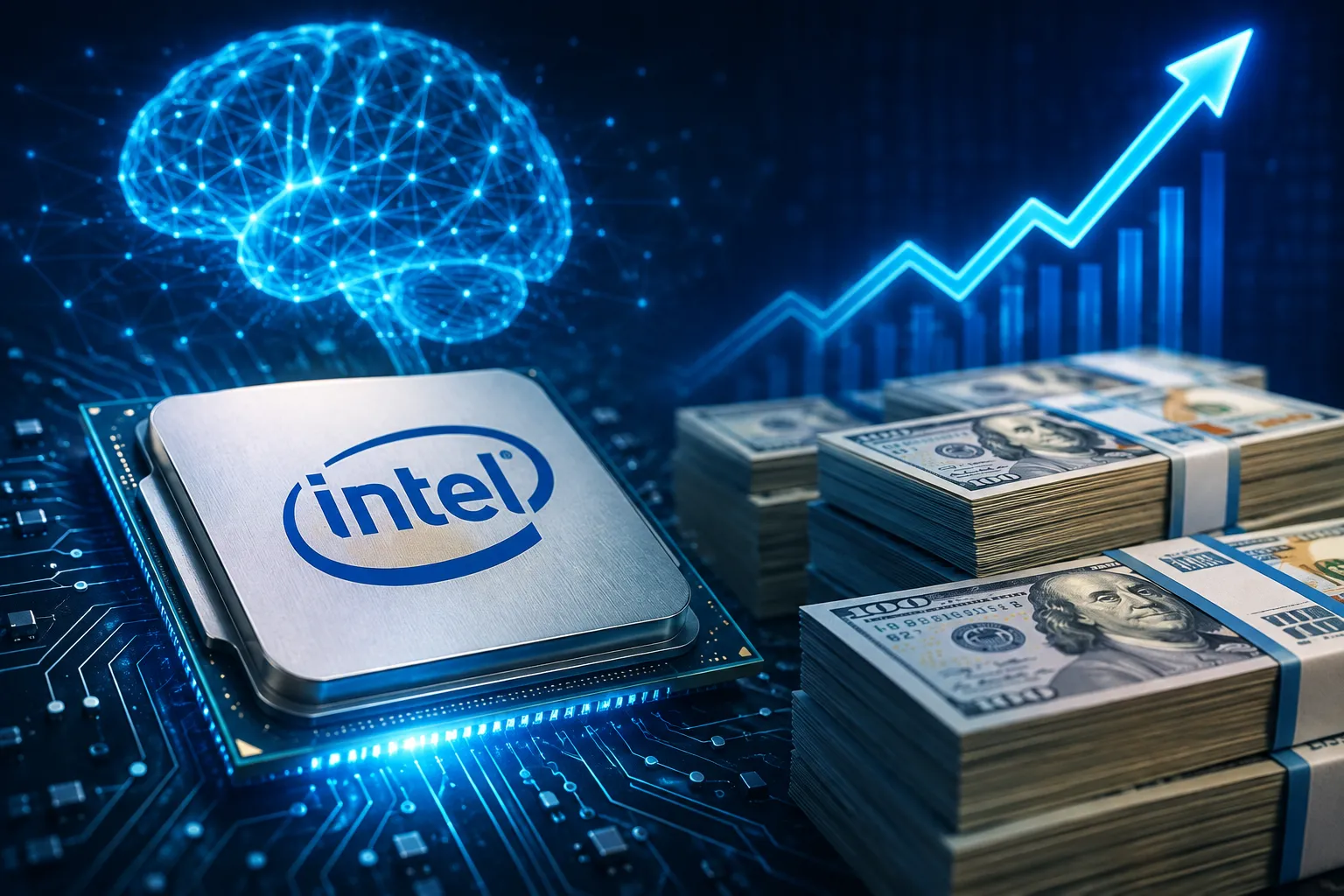
Intel announced on 10 August 2026 a $15 billion common stock offering, a figure promptly raised to $20 billion. The share issue was priced at $95 per share, a discount of more than 2.5% to the previous session’s close of $97.52. The American chipmaker cites “strong and sustainable” customer demand tied to artificial intelligence. Here is why the move deserves your attention, even if you never buy a share.
What Intel announced, precisely
A stock offering means a listed company creates and sells new shares to raise cash. It is an alternative to bank debt or bond issuance. The trade-off is mechanical: existing shareholders see their relative stake diluted, since more shares are now in circulation.
Intel first announced a $15 billion target, then raised it to $20 billion. That upsizing mid-operation is itself a signal: it indicates investor demand exceeded the initial supply.
The company said the funds are earmarked for general corporate purposes, including capital expenditures and working capital. Management named three growth areas: physical AI, meaning artificial intelligence embedded in machines and robots rather than servers, purpose-built silicon designed for a specific customer, and advanced packaging.
Advanced packaging, the real industrial battle
That last point is worth pausing on, because it is currently one of the industry’s main bottlenecks.
Historically, a processor was a single chip etched in one piece. That approach is hitting its limits: beyond a certain size, defect rates spiral and costs become unsustainable. The industry therefore now assembles several small specialised dies, called chiplets, inside a single package, linking them with extremely dense interconnects. That is advanced packaging.
This step has become critical because it governs the production of AI accelerators, which pair a compute die with stacks of high-bandwidth memory. Global advanced packaging capacity is limited, and it is today one of the factors capping AI chip output, more so than lithography itself.
A mixed financial backdrop
The offering comes during an unusual stretch for Intel. In late July the chipmaker reported quarterly results showing its fastest revenue growth in almost fifteen years, carried by the AI wave. The stock nonetheless fell after that release, with investors focusing on guidance and on the capital intensity of the industrial plan.
It is also worth recalling Nvidia‘s $5 billion stake in Intel, taken at $23.28 per share. Set against the $95 of the current offering, the gap illustrates how far the stock has travelled — and the market window Intel is choosing to use today.
On the technology side, Intel presented its Xeon 6+ line at Computex 2026, codenamed Clearwater Forest, built on its in-house 18A node, with a top model reaching 288 cores and 576 MB of third-level cache. That was the industrial proof point the foundry owed its customers after several years of delays.
What it changes for you
A Wall Street capital raise may feel remote from daily life. It is not entirely.
First, these $20 billion fund production capacity. The industry has spent several months under severe strain on memory and storage, as manufacturers redirect their lines towards components for AI data centres, which are far more profitable. That shift is already showing up in consumer RAM and SSD prices. Any additional capacity brought online in the medium term helps ease the constraint.
Second, competition between foundries ultimately benefits buyers. A financially solid Intel facing TSMC and Samsung keeps pressure on prices and on the pace of innovation. Conversely, a lasting weakening of Intel would concentrate leading-edge manufacturing in even fewer hands.
Finally, some perspective is needed. A stock offering is not revenue. It is a bet on the future, funded by investors, which assumes AI-driven demand holds up long enough to pay back fabs whose construction is measured in years.
In summary
With this $20 billion stock offering, Intel gives itself the means to accelerate on advanced packaging and AI-dedicated production capacity. The operation, oversubscribed to the point of being upsized mid-course, reflects real market confidence.
Above all it is a reminder that the AI race has become an industrial race, won by whoever can manufacture, not merely by whoever can design.
This article is provided for information purposes and does not constitute investment advice.
Do you think these investments will bring component prices down? Share your analysis in the comments.
Read also:
- Walmart finally accepts Apple Pay and Google Pay in its stores
- App Store: Apple lowers its commissions in Europe to settle the DMA dispute
Share this content:





Post Comment