
Xiaomi has officially launched the Xiaomi Xring O3, its new in-house mobile chip, at its XRING technology conference on 24 August 2026. The Chinese manufacturer claims an AnTuTu score of 5.22 million points, which would make it the first smartphone processor to break the five-million barrier. Built on a 3-nanometre process, fitted with a ten-core CPU and the first LPDDR6 support in the mobile market, the Xring O3 will power the Xiaomi 18 Fold and the Pad 9 Pro Max tablet, both due in September in China. Pre-orders for the foldable are already open.
Behind the headline numbers lies a much broader industrial battle: Xiaomi’s independence from Qualcomm and MediaTek. Here is our analysis.
Xiaomi Xring O3: what are these numbers really worth?
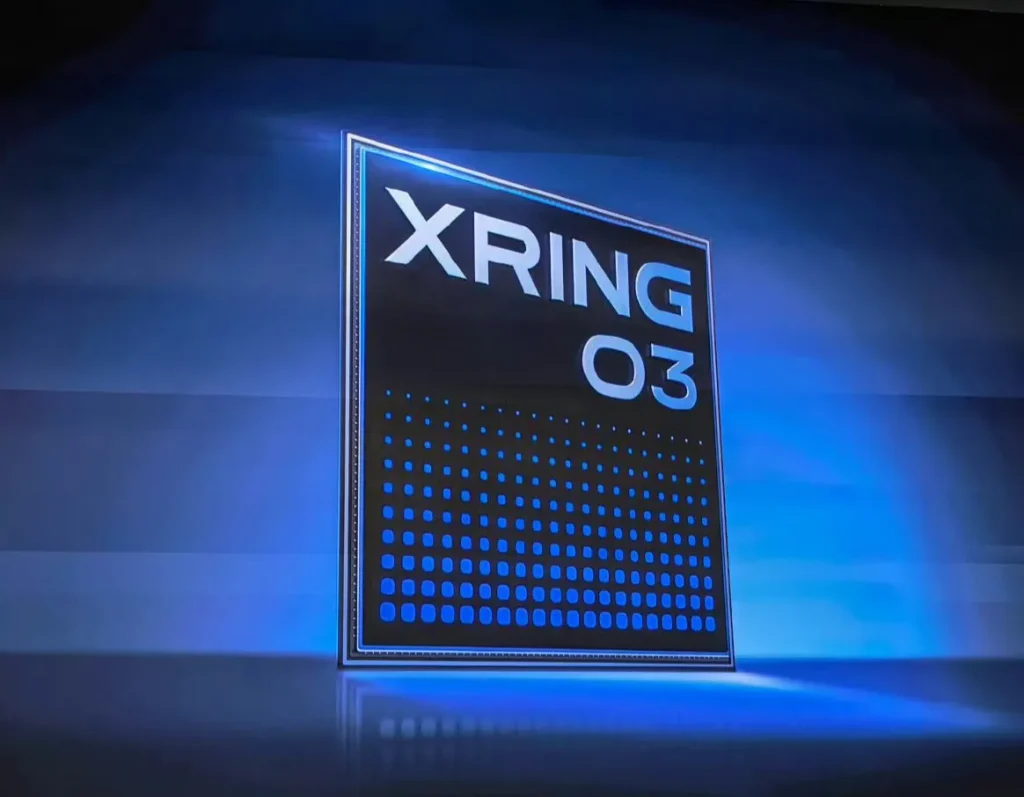
Let us start with the spec sheet as communicated by Xiaomi. The Xring O3 is built on a 3 nm process and packs 24 billion transistors into a die area of roughly 133 mm². For context, that is a transistor budget comparable to the latest generation of high-end SoCs.
The CPU configuration is unusual: ten cores, all of the performance type, with no classic low-power core. There are two C1-Ultra cores clocked up to 4.35 GHz, four C1-Premium cores at 3.68 GHz and four C1-Pro cores at 3.15 GHz. Xiaomi claims a CPU performance gain of up to 60 percent over the previous generation.
Graphics are handled by a 16-core G2-Ultra NX GPU. The company claims up to 85 percent more graphics performance and 64 percent better power efficiency. In synthetic tests, Geekbench reportedly returns around 3,945 points single-core and 15,221 points multi-core, while AnTuTu reaches 5.22 million points.
A word of caution is needed. These are manufacturer figures, obtained on prepared test units under thermal conditions rarely representative of real use. An AnTuTu score measures peak performance over a few minutes, not the sustained performance of a phone in your pocket after twenty minutes of gaming. Independent measurements on retail devices will be needed to settle the matter.
LPDDR6: the genuine technical novelty
Beyond the scores, the Xring O3’s most concrete innovation lies elsewhere. The chip is the first in the mobile market to support LPDDR6 memory, successor to the LPDDR5X found in the overwhelming majority of high-end smartphones today.
LPDDR6, short for Low Power Double Data Rate 6, is a memory standard designed for mobile devices that prioritises bandwidth while limiting power draw. Xiaomi announces speeds of up to 10,667 Mbps and memory bandwidth of 113.8 GB/s, a 48 percent increase over the previous-generation Xring O1.
Why does this matter? Because artificial intelligence models running directly on the device are extremely hungry for memory bandwidth. Running a language model locally, without going through the cloud, depends less on raw processor power than on how fast data moves between memory and the compute units. That is precisely the bottleneck LPDDR6 aims to relieve.
A chip designed for on-device artificial intelligence

Xiaomi indeed emphasises this angle. The Xring O3 claims 200 TOPS of tensor performance and 3.13 TFLOPS of vector compute, with an NPU (the unit dedicated to neural networks) said to be 45 percent faster than the previous generation.
One interesting point: artificial intelligence acceleration is not confined to the NPU alone. It is distributed across the CPU, GPU, ISP (the image signal processor that handles photos), DPU and ADSP, with static latency quoted at 82 nanoseconds. This distributed approach theoretically allows several artificial intelligence tasks to run in parallel, for example enhancing a photo while a voice assistant runs locally.
Xiaomi notes that developing the chip took 459 days, a figure highlighted to underline the growing maturity of its semiconductor design team.
Xring O100 and D100: the silicon strategy unfolds

The Xring O3 was not alone on stage. Xiaomi presented two further chips that sketch out a wider strategy.
- Xring O100: built on 6 nm, this is an artificial intelligence accelerator using a so-called near-memory architecture. It stacks chip and memory vertically to shorten the distance data must travel, and claims bandwidth of up to 1.22 Tbps. Xiaomi intends it for local model execution on phones, cars and robots.
- Xring D100: built on 3 nm, this is Xiaomi’s first in-house intelligent-driving chip. It carries a 20-core CPU, a 16-core NPU, and supports up to 160 GB of unified memory to run models of up to 200 billion parameters locally. Development is complete, but commercial availability is only planned for 2027.
The goal is clear: cover phone, car and computer with in-house silicon. A trajectory reminiscent of Apple with its A then M series chips, and of Huawei with its Kirin line after the US sanctions.
Xiaomi 18 Fold: the foldable that will introduce the chip

The first device to carry the Xring O3 will be the Xiaomi 18 Fold, confirmed for a September launch in China. Pre-orders are already open on the Chinese market. Xiaomi announces a wide foldable design without yet detailing the full spec sheet. The Xiaomi Pad 9 Pro Max tablet will also receive the chip.
An important caveat for European readers: both products are currently announced for China only. Xiaomi has communicated no international release schedule, and the brand’s track record with foldables invites caution. The Xiaomi Mix Fold never left the Chinese market. There is therefore no guarantee that the first Xring O3 phone will ever be sold in Europe.
What it changes for you
In the short term, not much that is directly tangible if you buy your phones in Europe. But a credible third player in high-end mobile processor design has deeper consequences.
First on prices. Qualcomm and MediaTek currently share most of the high-end mobile silicon market, and chip cost represents a growing share of a smartphone’s price. A Xiaomi able to supply itself reduces its dependence and gains pricing room, at a time when the memory shortage is already pushing prices up across the industry.
Then on innovation. LPDDR6 will reach competitors anyway, but being first to implement it gives Xiaomi an experience lead on on-device artificial intelligence, a field that will shape the next generations of phones.
Finally, some perspective. A chip is not judged on a benchmark score but on a whole package: driver stability, photo processing quality, thermal management, application compatibility, and above all long-term software support. That is precisely where established players keep their edge, and where the Xiaomi Xring O3 will have to prove itself.
What do you make of Xiaomi’s silicon offensive? Does a credible third mobile chip designer look like good news for consumers? Share your view in the comments and find our other mobile processor market analyses on Wanda-techs.
Read also:
Xiaomi AI Cube: the mini-PC that runs AI without the cloud
Share this content: