
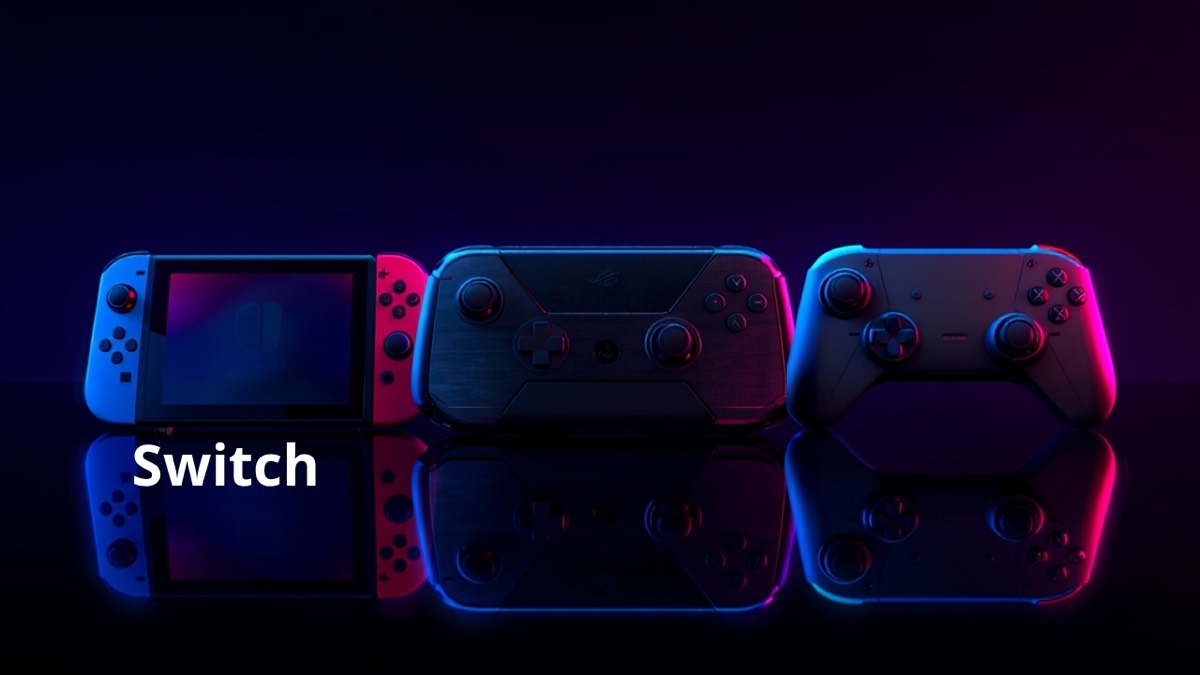
Handheld gaming has never been so contested: the Nintendo Switch 2, hybrid and queen of exclusives, the Steam Deck OLED, best value in PC handhelds with its Steam ecosystem, and the Asus ROG Ally, the most powerful on Windows, able to run anything. Three very different philosophies: depending on whether you play Nintendo, Steam or “everything,” one stands out. Here, criterion by criterion and use case by use case, is how to decide.
At a glance: the match in one table
| Criterion | Nintendo Switch 2 | Steam Deck OLED | Asus ROG Ally |
|---|---|---|---|
| Indicative price | around €449 | around €569 (512 GB) | around €649 |
| System | Nintendo (hybrid TV/handheld) | SteamOS (Linux) | Windows 11 |
| Power | High (custom Nvidia chip, DLSS) | Moderate but highly optimized | The most powerful |
| Screen | 7.9” LCD 120 Hz HDR | 7.4” OLED 1000 nits HDR | 7” IPS 120 Hz |
| Games | Nintendo exclusives | Huge Steam library | Steam, Game Pass, Epic… everything |
| Simplicity | Maximum | Very good (smooth SteamOS) | Windows, more tinkering |
| Key strength | Exclusives + hybrid TV | Value + OLED screen | Power + flexibility |
System and games: three universes
This is the deciding point, because the three don’t play the same games. The Switch 2 is the only one to offer Nintendo exclusives (Mario, Zelda, Mario Kart…) and the hybrid mode: handheld, then docked to play on the TV. The Steam Deck OLED gives access to your huge Steam library in a smooth SteamOS system built for handheld. The Asus ROG Ally, on Windows 11, is the most open: Steam, Game Pass, Epic, emulators… it runs almost anything, at the cost of an interface less optimized for the handheld format.
Power and performance
The Asus ROG Ally is the most powerful thanks to its AMD chip, able to run demanding PC games at good detail levels. The Steam Deck OLED is less powerful on paper, but its exemplary software optimization lets it run most of the catalog smoothly with relatively excellent battery life. The Switch 2 relies on a custom Nvidia chip with DLSS (AI upscaling), very effective for Nintendo and compatible games. For raw PC power, ROG Ally; for the performance/optimization balance, Steam Deck; for first-party games, Switch 2.
Screen
The Steam Deck OLED has the best screen: a 7.4-inch OLED panel, very bright (up to 1,000 nits in HDR), with perfect blacks. The Switch 2 offers a large 7.9-inch LCD at 120 Hz with HDR, pleasant and smooth. The Asus ROG Ally offers a 7-inch IPS screen at 120 Hz, decent but without OLED’s contrast. For pure picture quality, the Steam Deck OLED wins.
Format, battery and comfort
The Switch 2 is the most versatile with its hybrid mode (TV + handheld) and detachable Joy-Con. The Steam Deck is bigger and heavier, but very ergonomic for long sessions. The Asus ROG Ally is lighter than the Steam Deck. Battery life depends heavily on the games run, but the less power-hungry consoles (Switch 2, Steam Deck on light games) generally last better than the ROG Ally pushed to the max. For usage flexibility, Switch 2; for ergonomics, Steam Deck.
Price
The Switch 2 is the most affordable (around €449), the Steam Deck OLED sits around €569 for 512 GB, and the Asus ROG Ally climbs to around €649. The more power and openness (Windows) you add, the higher the price. For the best entry ticket, Nintendo; for PC value, Steam Deck.
Nintendo Switch 2 — Pros / Cons
Pros:
- Nintendo exclusives (found nowhere else)
- Hybrid mode (handheld + TV via dock)
- The simplest and most affordable
- Detachable Joy-Con, DLSS
Cons:
- Catalog limited to the Nintendo ecosystem
- LCD screen (no OLED)
- Less open to PC games
Steam Deck OLED — Pros / Cons
Pros:
- Best screen (OLED 1,000 nits HDR)
- Huge Steam library, smooth SteamOS
- Excellent value for money
- Very good ergonomics
Cons:
- Less powerful than the ROG Ally
- Bigger and heavier
- No Nintendo exclusives
Asus ROG Ally — Pros / Cons
Pros:
- The most powerful (demanding PC games)
- Windows 11: Steam, Game Pass, Epic… everything
- 120 Hz screen, light
- Maximum flexibility
Cons:
- Windows less optimized for handheld
- The most expensive, variable battery life
- Some software tinkering
Verdict: which one should you choose?
- Choose the Nintendo Switch 2 if you want Nintendo exclusives, the hybrid TV/handheld mode and simplicity, at the best price.
- Go for the Steam Deck OLED if you have a Steam library, if you want the best screen and best value in PC handhelds, with a smooth system.
- Get the Asus ROG Ally if you want maximum power and the flexibility of Windows (Game Pass, all stores, emulation), and price isn’t a barrier.
Three excellent handhelds, three audiences: Nintendo for exclusives and simplicity, Steam Deck for value and OLED, ROG Ally for power and openness. It’s up to you to say what matters most.
Conclusion
Exclusives and hybrid at Nintendo, value and OLED at Valve, power and Windows at Asus: the best handheld depends on your games. Which would you slip into your bag? Tell us in the comments and find our other comparisons on Wanda-techs.
As an Amazon Associate, Wanda-techs earns from qualifying purchases. This affects neither our independent analysis nor the price you pay.
Share this content: