

Building or upgrading a gaming PC around €300 to €400? Two cards fight over the heart of the market: the Nvidia GeForce RTX 5060, backed by DLSS 4 and excellent ray tracing, and the AMD Radeon RX 9060 XT, which bets on more VRAM and slightly higher raw performance at 1080p. Nvidia and AI on one side, AMD and memory on the other: the right choice mostly depends on what you play. Here is how to decide, criterion by criterion and use by use.
At a glance: the match in one table
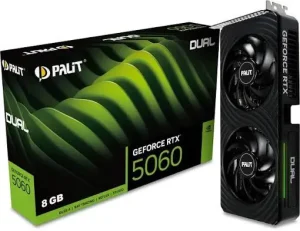
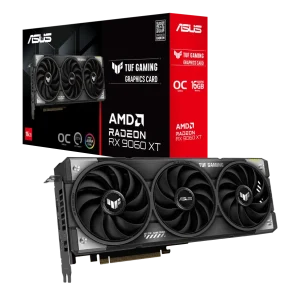
| Criterion | GeForce RTX 5060 | Radeon RX 9060 XT 16 GB |
|---|---|---|
| Street price | about €319 (8 GB) | about €379 (16 GB) |
| Video memory | 8 GB GDDR7 | 8 or 16 GB GDDR6 |
| Raw 1080p performance | Very good | 5 to 10% faster |
| Ray tracing | Better | Decent |
| Upscaling | DLSS 4 (multi frame generation) | FSR |
| Creation and streaming | Excellent NVENC encoder | Good, one step behind |
| Rounds won | 4 | 2 |
VRAM: AMD’s strongest argument
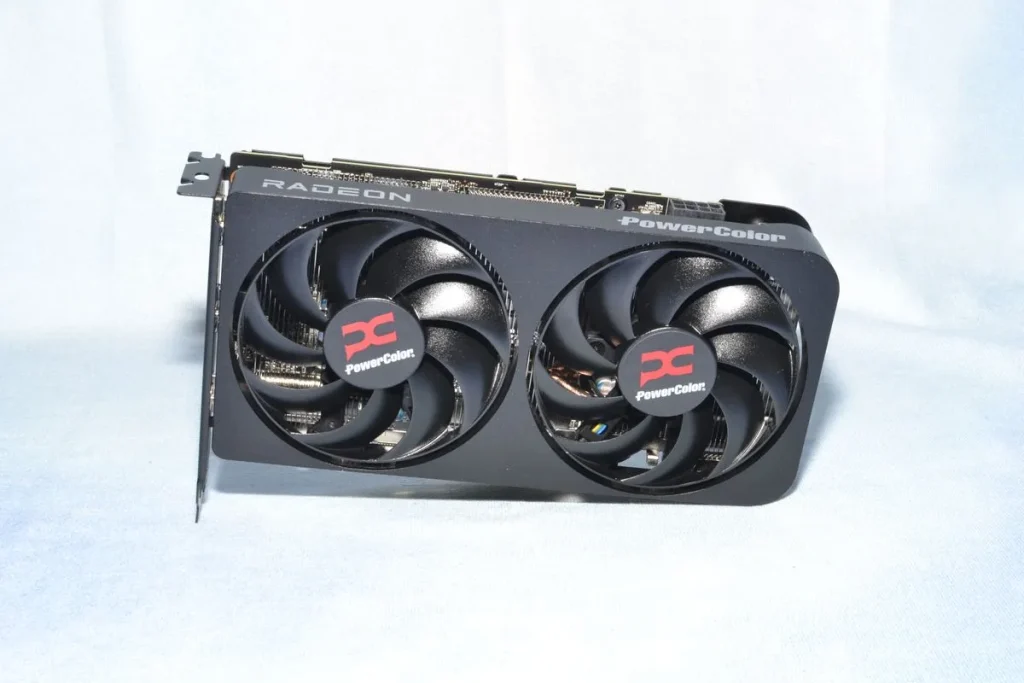
This is THE big difference. The RTX 5060 is limited to 8 GB of video memory, while the RX 9060 XT comes with 8 or 16 GB, and the 16 GB model is the one to go for. More and more recent games, especially with high textures, at 1440p or with mods, want more than 8 GB to avoid stutter. For longevity and comfort in demanding games, the Radeon’s 16 GB give real headroom the RTX 5060 does not have. It is AMD’s number one asset.
Gaming performance (1080p and 1440p)
In traditional rendering (rasterisation), the RX 9060 XT takes a small lead, around 5 to 10% depending on the game, which makes it an excellent 1080p card that can push towards 1440p with upscaling. The RTX 5060 is still very capable and catches up as soon as ray tracing is on, where Nvidia’s architecture is more efficient, and above all thanks to DLSS 4 with multi frame generation, which multiplies frame rates in supported games. Pure raster: AMD. Ray tracing and upscaling: Nvidia.
Ray tracing, DLSS and features
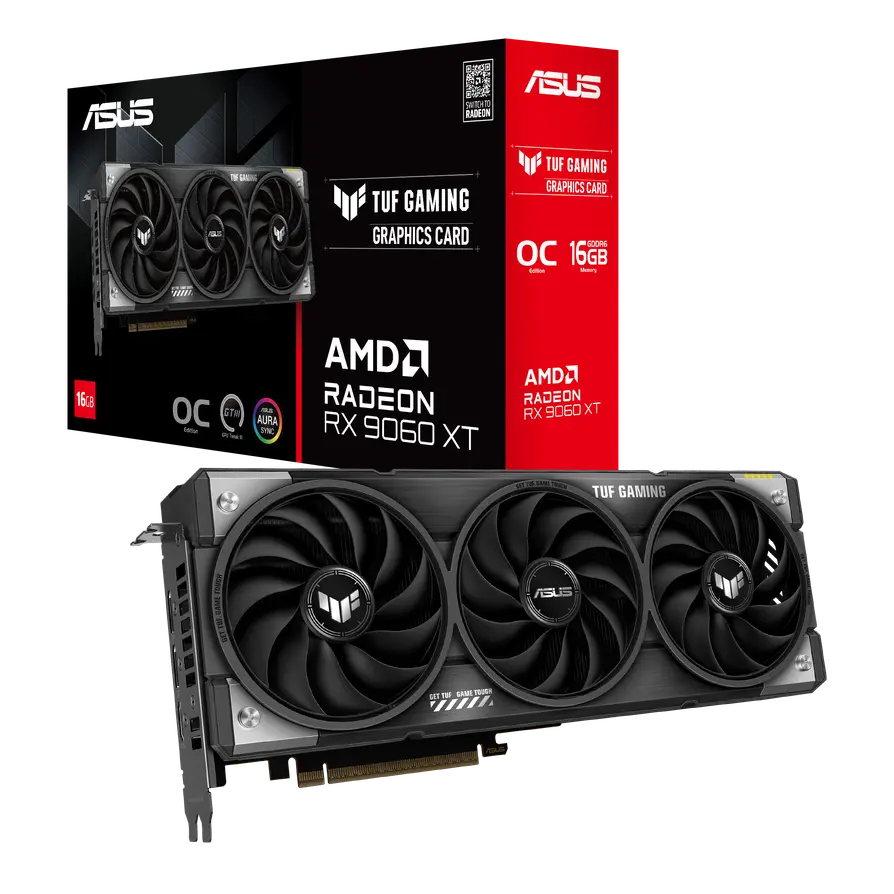
This is Nvidia’s home turf. The RTX 5060 uses DLSS 4, the most mature upscaling and frame generation technology on the market, and handles ray tracing (realistic lighting) better. AMD answers with FSR, much improved but still a step behind DLSS in quality and adoption. If you play titles built around ray tracing and DLSS, the RTX 5060 gives the best image at the same smoothness.
Content creation and streaming
For creators and streamers, the RTX 5060 keeps an edge thanks to Nvidia’s NVENC encoder, well regarded for streaming (OBS) and video editing, and a more mature ecosystem of AI apps. The RX 9060 XT does well but stays a step behind on encoding. If you stream or edit regularly, Nvidia is the safer bet.
Specifications
GeForce RTX 5060
| Architecture | Blackwell |
|---|---|
| Cores | 3,840 CUDA cores |
| Boost clock | 2.50 GHz |
| Memory | 8 GB GDDR7 |
| Memory bus | 128-bit |
| Power | 145 W |
| Upscaling | DLSS 4 (multi frame generation) |
| Street price | about €319 |
Radeon RX 9060 XT
| Architecture | RDNA 4 |
|---|---|
| Cores | 2,048 stream processors (32 compute units) |
| Boost clock | up to 3.13 GHz |
| Memory | 8 or 16 GB GDDR6 |
| Memory bus | 128-bit |
| Power | 160 W (typical) |
| Upscaling | FSR |
| Street price | about €379 (16 GB) |
Price and availability
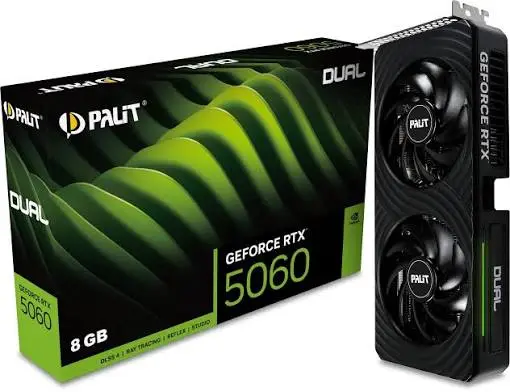
The RTX 5060 (8 GB) is a little cheaper (around €319) than the RX 9060 XT 16 GB (around €379). But per gigabyte of memory and per frame of raw performance, the Radeon gives better value, especially over time. The RTX 5060 remains unbeatable if ray tracing, DLSS and encoding come first.
RTX 5060: where to buy
- Amazon best price319 €
Affiliate links: we may earn a commission, at no extra cost to you. Prices checked on September 11, 2026.
Radeon RX 9060 XT: where to buy
- Amazon best price379 €
Affiliate links: we may earn a commission, at no extra cost to you. Prices checked on September 11, 2026.
RTX 5060: pros and cons
Pros:
- DLSS 4 with multi frame generation
- Better ray tracing
- Excellent NVENC encoder (streaming, editing)
- A little cheaper, mature AI ecosystem
Cons:
- Only 8 GB of VRAM (a limit in demanding games)
- Slightly lower raw 1080p performance
- Less future-proof with high textures
Radeon RX 9060 XT: pros and cons
Pros:
- 16 GB VRAM model (longevity, 1440p, mods)
- Higher raw 1080p performance
- Better price per gigabyte
- Full PCIe x16 interface
Cons:
- Ray tracing behind Nvidia
- FSR still a step behind DLSS 4
- Encoding and streaming a little less polished
Verdict: which one should you pick?
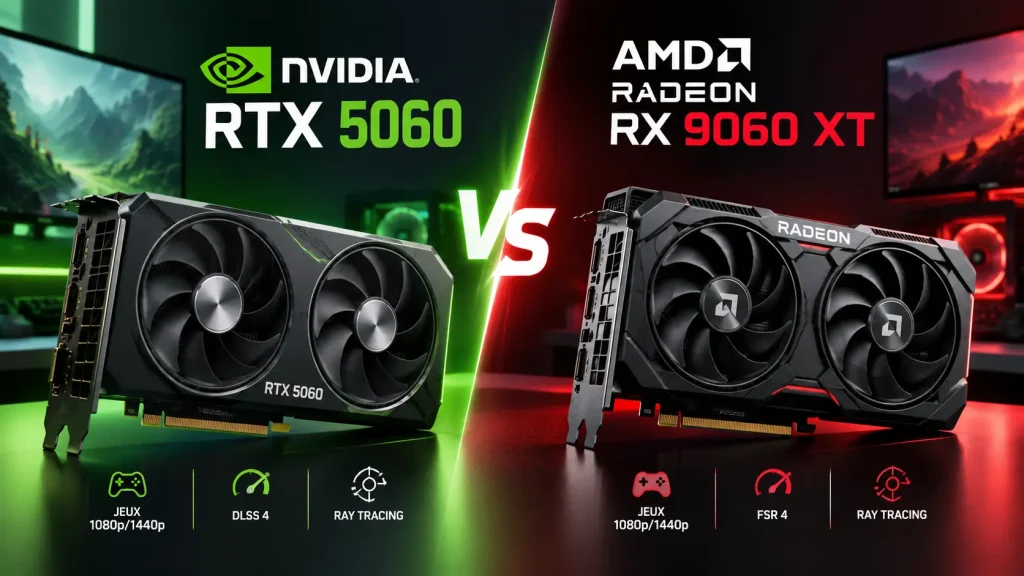
- Choose the RTX 5060 if you play games with ray tracing and DLSS, if you stream or edit videos, and if you want the best image at the same smoothness.
- Go for the Radeon RX 9060 XT (16 GB) if you want the best raw performance at 1080p and 1440p, more VRAM to last and the best value for money.
For most gamers who want performance and memory that lasts, the RX 9060 XT 16 GB is the smart choice. For ray tracing, DLSS 4 and content creation, the RTX 5060 keeps the edge. Two excellent mid-range cards, depending on your games and your uses.
Where to buy at the best price
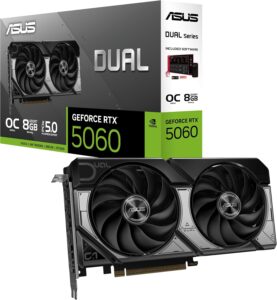
ASUS Dual GeForce RTX 5060 8 Go OC
Carte graphique GDDR7 8 Go, DLSS 4, PCIe 5.0, format 2,5 slots, ventilateurs silencieux au repos.
- AmazonSee at Amazon
- CdiscountSee at Cdiscount
- FnacSee at Fnac
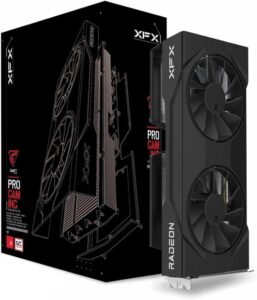
XFX Swift Radeon RX 9060 XT 16 Go
Carte graphique AMD RDNA 4 avec 16 Go de GDDR6, FSR 4, HDMI et 2 DisplayPort.
- AmazonSee at Amazon
- FnacSee at Fnac
Conclusion
VRAM and raster with AMD, ray tracing and DLSS with Nvidia: the best graphics card depends on your games and your priorities. Which one would you put in your tower? Tell us in the comments and find our other component comparisons on Wanda-techs.
As an Amazon Associate, Wanda-techs earns from qualifying purchases. This affects neither our independent analysis nor the price you pay.
Share this content: