
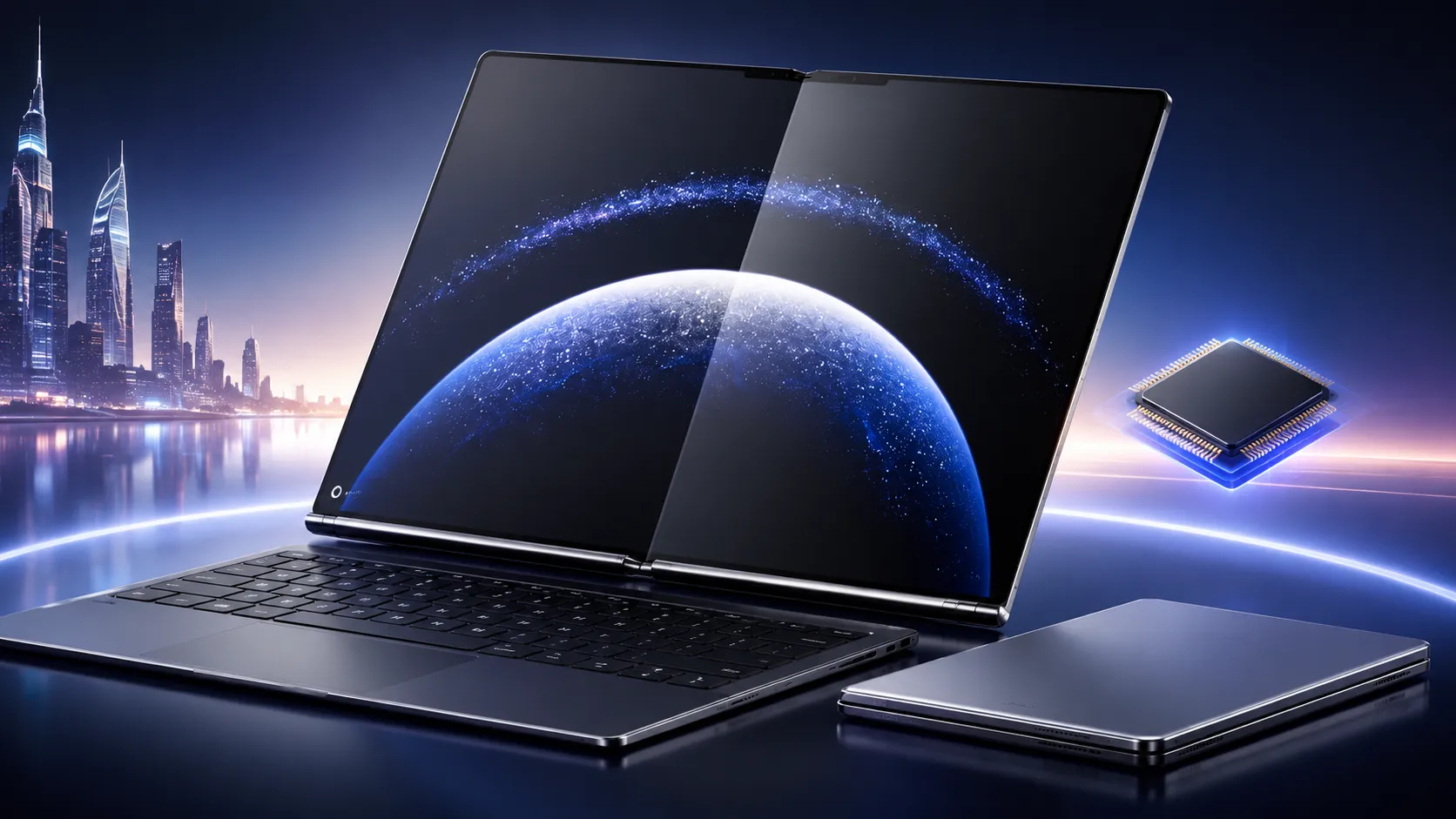
On 5 August 2026, Huawei officially unveiled the second generation of its MateBook Fold Ultimate Design, the 18-inch foldable-screen laptop that folds down to roughly the footprint of a 13-inch machine. The 2026 edition brings a new in-house Kirin X90 Plus chip, a redesigned liquid-metal hinge, HarmonyOS 6.1 and, above all, an M-Pencil stylus with built-in AI features. Prices start at 24,999 yuan, or around 3,700 dollars, and the laptop is currently China-only. Here is everything worth knowing about this unusual machine.
An 18-inch screen that fits in a 13-inch bag
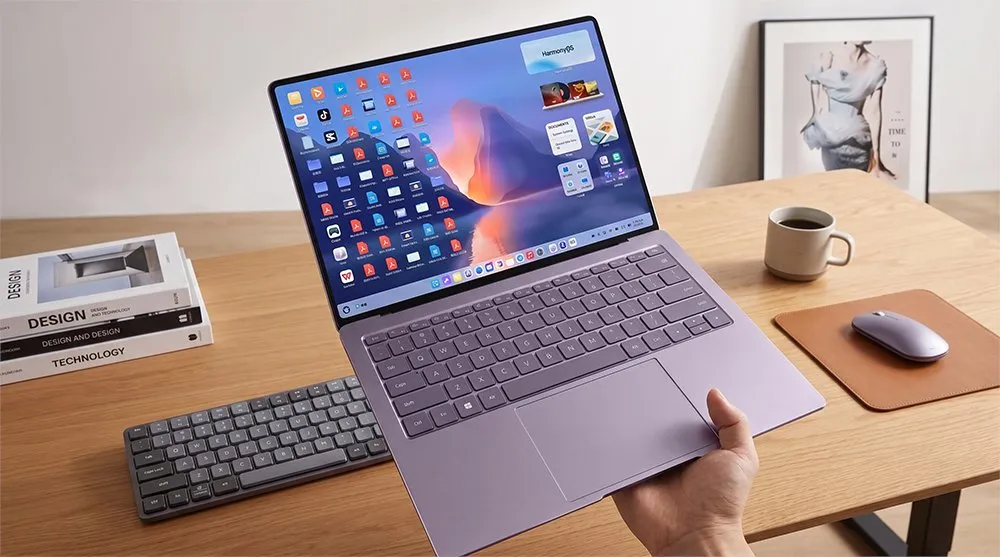
The heart of the MateBook Fold Ultimate Design 2026 is obviously its display. Huawei keeps the first generation’s formula: a dual-layer OLED panel measuring 18 inches diagonally when unfolded, which folds in on itself down to the footprint of a 13-inch laptop. In other words, you carry a 13-inch and work on an 18-inch.
The specifications hold up. Resolution reaches 3.3K, peak HDR brightness hits 1,600 nits, and the refresh rate is adaptive thanks to LTPO technology, a panel type able to continuously adjust its frequency to save battery when the image is static. The screen-to-body ratio climbs to 92 percent, which means unusually thin bezels for a device this size.
One important point on protection: Huawei uses ultra-thin glass, or UTG, the same principle found on high-end foldable smartphones. This is what allows an OLED panel to fold tens of thousands of times without cracking, while keeping a pleasant touch surface.
Kirin X90 Plus: Huawei keeps moving without Western silicon
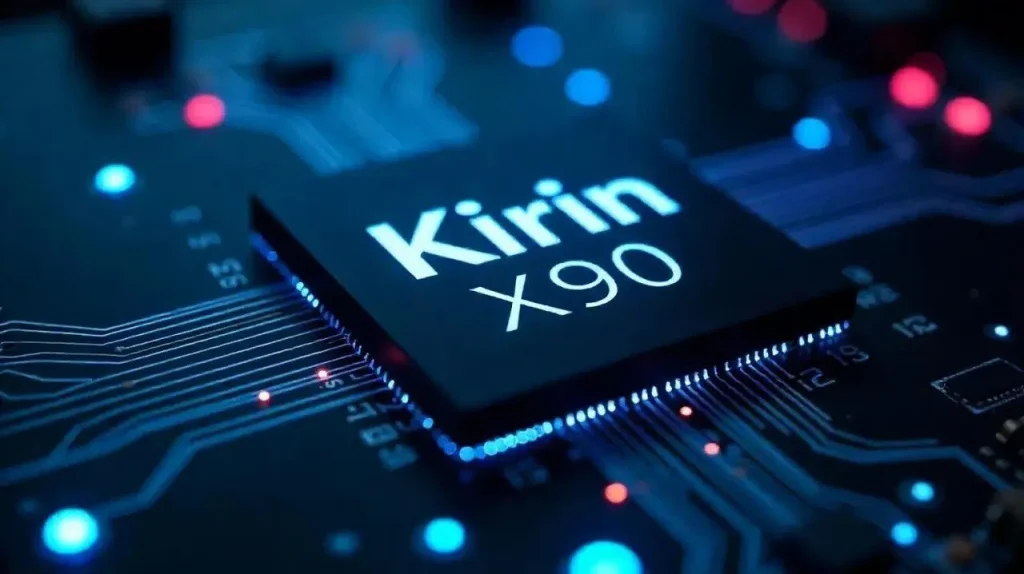
This is the most significant change of this iteration. The MateBook Fold 2026 drops the previous generation’s chip in favour of the Kirin X90 Plus, an ARM processor designed in-house by Huawei. The company claims roughly 25 percent smoother performance than the outgoing generation, within a 28-watt thermal envelope.
That 28 W figure is worth decoding. It places the machine in the high-performance ultraportable category: enough headroom for heavy office work, photo editing and sustained multitasking, without targeting workstation-class workloads. That is consistent with the format, since a 1.16 kg foldable chassis leaves no room for a bulky cooling system.
On that note, Huawei has fitted an ultra-thin vapour chamber to dissipate heat. According to the company, it limits performance drops during long sessions, the familiar throttling that cuts processor frequency when temperatures climb too high.
As for configurations, the device comes with 24 GB or 32 GB of RAM, and 512 GB to 2 TB of SSD storage. Note that there is no entry-level version: even the cheapest model starts at 24 GB of RAM, which remains generous compared with most ultraportables on the market.
A liquid-metal hinge: the real challenge for foldables
On a foldable product, the hinge is failure point number one. Huawei has therefore reworked its own for this 2026 edition, with what it presents as the largest waterdrop hinge ever fitted to one of its devices.
The term “waterdrop” refers to a folding geometry in which the screen forms a rounded loop rather than a sharp crease when closed. The benefit is twofold: mechanical stress on the panel is better distributed, and the crease mark is far less visible once the screen is opened.
The 2026 novelty lies in the materials. Some hinge components are now made from zirconium-based liquid metal, an amorphous alloy known for its hardness and resistance to deformation. Huawei promises better structural longevity and a smoother opening and closing action. On paper, this is exactly the kind of improvement early adopters of the previous generation were asking for.
The rest of the chassis follows the same premium logic: a silicone-coated vegan leather back, an integrated kickstand to prop the device up in landscape mode, and a contained weight of 1.16 kg. Powering it all is a dual-cell 74.69 Wh battery, or 6,400 mAh.
HarmonyOS 6.1 and an M-Pencil stylus that went AI
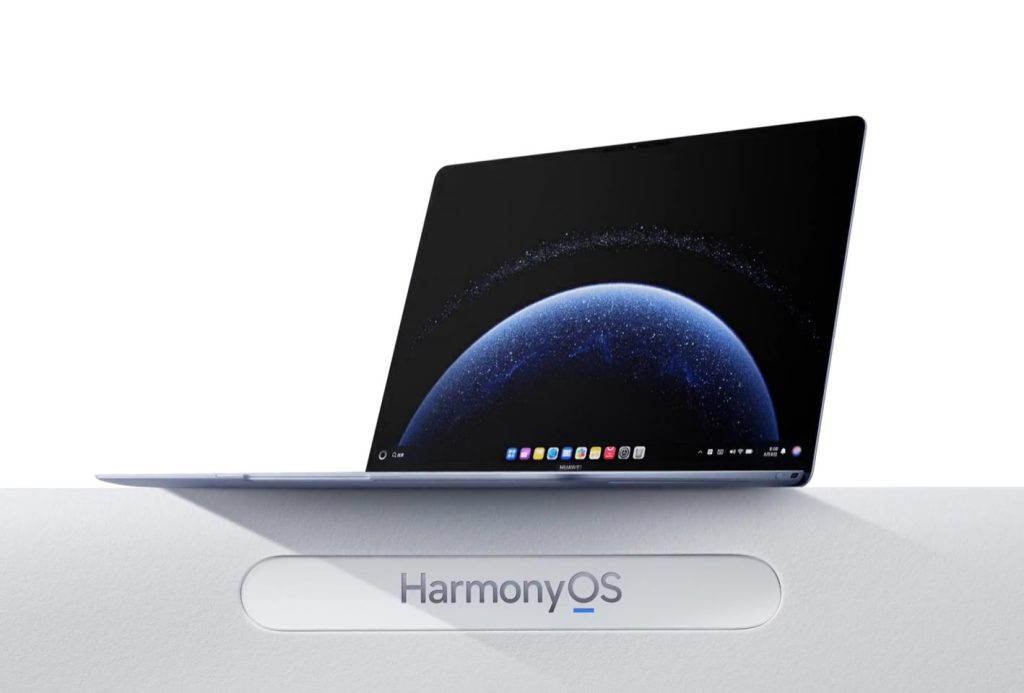
The MateBook Fold runs HarmonyOS 6.1, the latest version of Huawei’s in-house operating system. The software makes full use of the foldable format with three usage modes: tablet when the device is fully unfolded, laptop when folded at 90 degrees, and desktop when propped on its kickstand with an external keyboard.
In laptop configuration, the lower half of the screen turns into a virtual keyboard and trackpad. It is the logical solution for this kind of format, even if touch-typing on a glass surface remains an exercise that takes adjustment.
The real software novelty is the arrival of an M-Pencil stylus with artificial intelligence features. It is the first time Huawei has paired a stylus with this model. It is designed for handwriting, note-taking and sketching, with AI-assisted processing running directly on the device. HarmonyOS 6.1 indeed ships with on-device AI models powering the voice assistant and several productivity features, without systematic reliance on the cloud.
For video calls, Huawei settles for an 8-megapixel front camera. That is honest without being remarkable, and it remains probably the quietest line on the spec sheet.
Price and availability: China first, the rest of the world unclear
Three configurations have been announced, and the pricing confirms the machine’s ultra-premium positioning:
- 24 GB RAM + 512 GB storage: 24,999 yuan, around 3,700 dollars
- 24 GB RAM + 1 TB storage: 26,999 yuan
- 32 GB RAM + 2 TB storage: 29,999 yuan, around 4,440 dollars
At that price, the MateBook Fold Ultimate Design clearly is not aimed at the mainstream. It is a showcase product, meant to demonstrate Huawei’s industrial expertise in foldable displays and in-house silicon. The company has announced this machine for the Chinese market only, and no international release has been confirmed at this stage.
MatePad Pro 2026 and Nova 16 SE round out the event
The MateBook Fold was not alone on stage on 5 August. Huawei used its all-scenario launch event to also reveal the MatePad Pro 2026, a high-end tablet just 4.7 millimetres thick and weighing around 439 grams, likewise stylus-compatible and clearly aimed at creative work and productivity.
The company also launched the Nova 16 SE, a mid-range smartphone built around an 8,500 mAh battery, a display rated at 8,000 nits peak brightness and a 50-megapixel camera system. The contrast with the MateBook Fold is striking: on one side a technology demonstration above 3,500 dollars, on the other a device designed for volume.
What this actually changes
Do not expect to find a MateBook Fold Ultimate Design on European shelves in the coming months. The significance of this announcement lies elsewhere, and it is twofold.
First, it confirms that the foldable-screen laptop is gradually leaving the prototype stage. A second generation means the first sold well enough, or taught its maker enough, to justify further industrial investment. The announced improvements, namely a reinforced hinge, reworked cooling and a stylus, are typical of a product that is maturing rather than a concept.
Second, the Kirin X90 Plus is a reminder that Huawei has rebuilt a computer processor pipeline alongside its own operating system. For the global market, that means a third complete ecosystem, distinct from Windows and macOS, continues to consolidate, even if its reach remains essentially Chinese for now.
That leaves the awkward question: at what point does an 18-inch foldable screen become genuinely more practical than a good conventional 14-inch paired with an external monitor? The answer will depend heavily on how this new hinge holds up over time. We will of course be following the first real-world reports.
Would you swap your conventional laptop for a foldable-screen machine, or are you still waiting a few generations? Let us know in the comments.
Read also:
- 2026 RAM crisis: why your next PC and smartphone will cost much more
- AMD Ryzen 7 9800X3D vs. Intel Core Ultra 7 265K: which processor should you choose in 2026?
Share this content: