

The Galaxy S26 FE hit shelves this morning, 4 September 2026, wearing a 799-euro price tag for the 128 GB model. That is fifty euros more than last year’s S25 FE. For a spec sheet that has barely moved. Samsung puts forward three arguments: a chip built on a 3-nanometre process, a screen that can take direct sunlight, and six years of updates. Enough to justify the increase? That depends a great deal on what you want from a phone.
Galaxy S26 FE: price and availability
Three configurations make up the European catalogue:
- 8 GB of RAM and 128 GB of storage: 799 euros
- 8 GB and 256 GB: 899 euros
- 8 GB and 512 GB: 1,099 euros
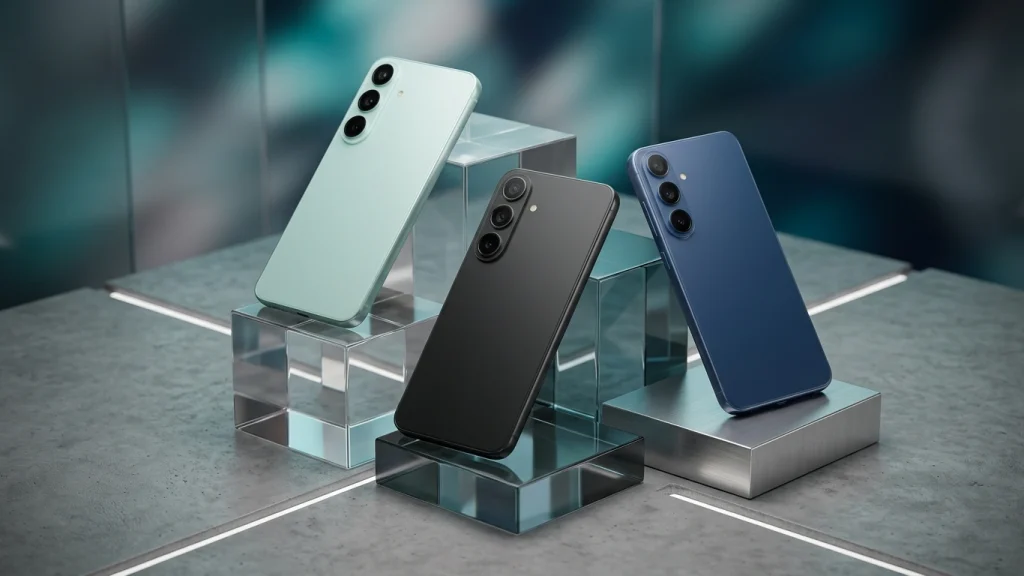
In the United States the entry price sits at 699.99 dollars. The rollout happened in two stages: several carriers opened sales on 3 September, with general distribution through Samsung’s own site and retailers taking over today. Three finishes are on offer: Aqua Green, Blue and Graphite.
The gap with the previous generation is worth pausing on. The S25 FE opened at 749 euros. Fifty euros more, in a segment where Chinese manufacturers line up aggressive spec sheets, is not a neutral variable. Part of the explanation lies in industrial conditions: memory is expensive in 2026, and nobody in the chain absorbs that instead of the end customer.
What the Fan Edition formula promises, and what it trims
A useful reminder for anyone new to the range. Fan Edition models are not arbitrarily cut-down versions. Samsung starts from the S series, keeps the elements users mention most in their feedback, then trims elsewhere. The screen, the software support and the waterproofing stay at flagship level. The compromises live in the processor, the amount of RAM, and sometimes the quality of the optical zoom.
The strategy worked well for a long time, because the price gap with a genuine flagship often exceeded 300 euros. At 799 euros that gap narrows, and the formula becomes harder to defend.

What sits inside the chassis
At the heart of the device: the Exynos 2500, Samsung’s in-house chip, built on a 3-nanometre process. A simple idea hides behind that number. The finer the process, the more transistors fit onto the same area of silicon, and the less energy each operation consumes. In practice this rarely translates into spectacular extra power, but rather into better-controlled heat during long sessions. It is paired with 8 GB of RAM, with no higher option in the catalogue.
The panel measures 6.7 inches. A Dynamic AMOLED 2X screen at Full HD+ resolution, running up to 120 Hz and peaking at 1,900 nits. That last figure is the one that genuinely counts. A 1,900-nit screen stays readable on a sun-blasted pavement in August, where an 800-nit panel forces you to cup your hand over it.
On the camera side, three modules at the back: a 50-megapixel main sensor at f/1.8 with optical stabilisation, a 12-megapixel ultra-wide at f/2.2 covering 123 degrees, and an 8-megapixel telephoto with 3x optical zoom. Nothing exotic, but the set covers everyday use with no obvious gap. A genuine telephoto at this price still counts as an argument: plenty of rivals make do with a digital crop in disguise.
Battery, format and software
The battery holds 4,900 mAh. Wired charging reaches 45 W, wireless charging 15 W through the Qi2 protocol. That last point deserves a clarification: Qi2 includes a magnetic ring that aligns the phone on the charger, much as Apple has done for several generations. No more waking up to a phone at 12 per cent because the coil drifted overnight.
On raw speed, Samsung stays behind. Some rivals exceed 100 W and fill a battery in around twenty minutes. The Korean company has always owned that choice: slower charging stresses the cells less and preserves their capacity over several years. A trade-off consistent with the promise of six years of support.

The device measures 161.6 x 76.9 x 7.4 mm and weighs roughly 193 grams, with IP68 certification against dust and immersion. It still fits in the hand, which is becoming rare at this screen size.
The S26 FE ships with Android 17 and the One UI 9 skin. Samsung commits to six years of updates. Translated into concrete terms: a phone bought today will still receive security patches in 2032. That changes how you should calculate the cost of a phone. Spread across the years, a 799-euro model supported for six years works out cheaper than a 500-euro device abandoned after two, and it spares you from buying a charger, a case and screen protectors again in between.
Is the Galaxy S26 FE worth it?
The contract holds, but the exercise gets uncomfortable at this price. At 799 euros you run into last year’s flagships on discount, often better equipped for photography and raw power. That is the paradox facing every mid-tier model: they compete less against direct rivals than against leftover stock from the previous generation.
The phone keeps three serious advantages. Screen brightness first, which puts it level with far pricier models. Software support next, hard to match elsewhere. And the Samsung ecosystem: if you already own a Galaxy watch or Buds earbuds, the continuity between devices is among the best executed on the market, and it vanishes the moment you switch brands.
Who should skip it? Demanding gamers, first of all, for whom 8 GB of RAM and the in-house chip will not hold the distance on the heaviest titles. Photographers next, who will find better elsewhere for the same money. And anyone who changes phone every two years: the six-year update promise, the device’s main selling point, does nothing for them.
If raw power weighs more than price in your decision, the standard Galaxy S26 remains the more coherent option in the catalogue, with its Exynos 2600 and a more compact body.
Check the Galaxy S26 price on Amazon

Where to buy the Galaxy S26 FE
Samsung Galaxy S26 FE 128 Go
Smartphone 5G de Samsung, écran 6,7 pouces, 128 Go de stockage.
- CdiscountSee at Cdiscount
- FnacSee at Fnac
- DartySee at Darty
The bottom line
The Galaxy S26 FE reinvents nothing, and does not try to. It is a solid, well-built, properly supported phone whose main flaw lies in where it sits on the price ladder rather than in its components. Samsung is betting on the loyalty of its existing base rather than on winning new buyers.
The bet may work. It does leave the door open to rivals in the 700 to 800 euro bracket, historically one of the most contested parts of the market, and the one where buyers compare longest before committing.
Torn between the S26 FE and a discounted flagship from last year? Tell us in the comments what matters most in your decision: the screen, the camera, or the length of software support.
As an Amazon Associate, Wanda-techs earns from qualifying purchases. This affects neither our independent analysis nor the price you pay.
Share this content: