Samsung T7 vs SanDisk Extreme: Which Portable SSD to Choose in 2026?
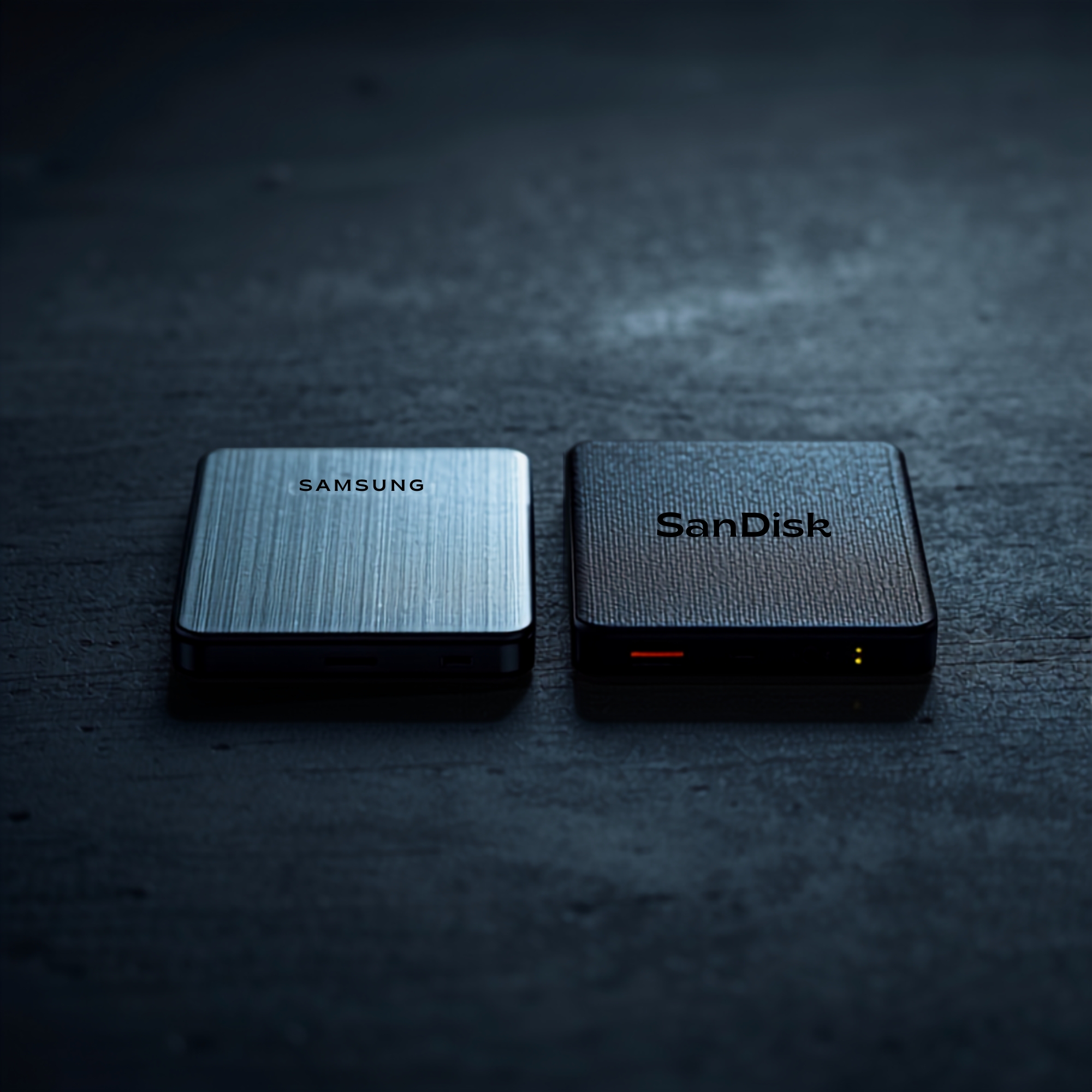
To carry your files, photos and 4K videos, two portable SSDs dominate: the Samsung T7, the benchmark for speed, security and sleek design, and the SanDisk Extreme, built for adventure with its water resistance and shock protection. Both reach 1,050 MB/s, but their philosophy differs: office and speed on one side, field and ruggedness on the other. Here, criterion by criterion and use case by use case, is how to decide.
At a glance: the match in one table
| Criterion | Samsung T7 | SanDisk Extreme |
|---|---|---|
| Indicative price (1 TB) | around €99 | around €99 |
| Speed (USB 3.2 Gen 2) | up to 1,050 MB/s (a bit more consistent) | up to 1,050 MB/s |
| Ruggedness | Sleek metal body (not water-resistant) | IP65 (water, dust), shock-resistant |
| Security | AES 256 hardware encryption + password | Software encryption |
| Format | Slim and light, card-sized | Compact with carabiner |
| Ideal for | Office, creation, speed, security | Field, travel, outdoors |
Speed and performance
Both SSDs leverage USB 3.2 Gen 2 and reach up to 1,050 MB/s read. In practice, the Samsung T7 proves slightly faster and more consistent: better IOPS (useful for launching apps or virtual machines from the drive) and well-maintained sustained throughput when writing large files (such as continuous 4K video). The SanDisk Extreme is barely behind, with excellent everyday performance. For creation and intensive transfers, the T7 has a slight edge.
Ruggedness and water resistance
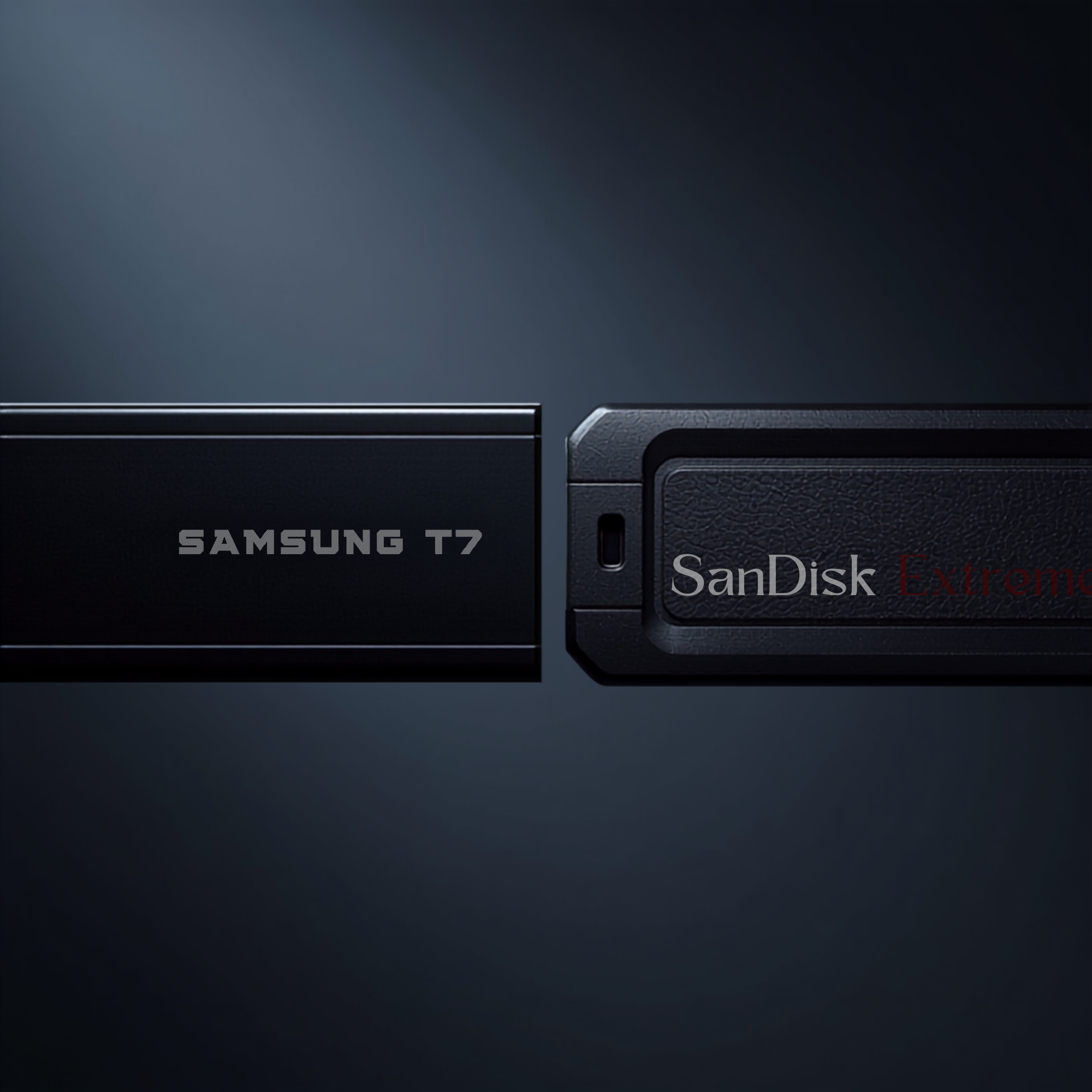
This is the SanDisk Extreme‘s turf: certified IP65 (water and dust resistant), with shock resistance and often a carabiner to clip to a bag, it’s built for the field, travel and the outdoors. The Samsung T7 (standard version) relies on a sleek, compact metal body, but without a water-resistance rating — for that, you need the T7 Shield variant. If you handle your SSD outdoors or in tough conditions, the SanDisk Extreme is more reassuring; for careful office use, the T7 is enough.
Data security
The Samsung T7 includes 256-bit AES hardware encryption with password protection (and sometimes fingerprint recognition on certain versions), a real plus for protecting sensitive data. The SanDisk Extreme also offers encryption, but managed in software. For protecting professional or confidential data, the T7 is more reassuring.
Format and portability
The Samsung T7 stands out with a slim and light design, barely bigger than a credit card, that slips into a pocket without a thought. The SanDisk Extreme is compact too, but a bit more “rugged,” with its rubber coating and handy carabiner to clip it. For discretion and elegance, the T7; for the clip and secure grip on the move, the SanDisk.
Price
Both sit around €99 for 1 TB, give or take a few euros and promotions. Price therefore doesn’t decide it: the choice comes down to use (speed/security at the office, or ruggedness/water resistance in the field).
Samsung T7 — Pros / Cons
Pros:
- A bit faster and more consistent (IOPS, sustained writes)
- AES 256 hardware encryption + password
- Slim, elegant and light format
- Ideal for creation and 4K transfers
Cons:
- Standard version not water-resistant (see T7 Shield)
- Less “rugged” than the SanDisk
SanDisk Extreme — Pros / Cons
Pros:
- IP65 certified (water, dust), shock-resistant
- Handy carabiner for transport
- Excellent everyday performance
- Ideal for field, travel, outdoors
Cons:
- Sustained throughput slightly behind the T7
- Software encryption (less integrated than the T7)
Verdict: which one should you choose?
- Choose the Samsung T7 if you want the best speed and consistency, hardware encryption for your sensitive data, and a slim, elegant format for office/creation use.
- Go for the SanDisk Extreme if you carry your SSD outdoors, traveling or in tough conditions, and if water resistance and shock protection take priority.
Both are excellent portable SSDs, very close in speed. The Samsung T7 is the office champion (speed, security, elegance); the SanDisk Extreme, the field champion (ruggedness, water resistance). It’s up to you to say where and how you’ll use it.
Conclusion
Speed and security at Samsung, ruggedness and water resistance at SanDisk: the best portable SSD depends on your use. Which would you slip into your bag? Tell us in the comments and find our other comparisons on Wanda-techs.
As an Amazon Associate, Wanda-techs earns from qualifying purchases. This affects neither our independent analysis nor the price you pay.
Share this content:





Post Comment